
Articles | Volume 7, issue 1
https://doi.org/10.5194/mr-7-15-2026
Educational article
 | 
11 Mar 2026
Educational article |  | 11 Mar 2026

The origin of mirror symmetry in high-resolution nuclear magnetic resonance spectra

Dmitry A. Cheshkov and Dmitry O. Sinitsyn
Abstract

A connection between the symmetry of high-field nuclear magnetic resonance (NMR) spectra, including higher-order spectra, and the properties of the spin system has been established. It is shown that, for a spectrum to be symmetric about the mid-resonance frequency (ν0), two conditions must be satisfied: (1) the resonance frequencies of the spins must be symmetrically positioned about ν0, and (2) there must exist at least one spin ordering with a monotonic increase (or decrease) in resonance frequencies such that the spectrum is invariant under the reflection of the J-coupling matrix about its anti-diagonal (one way to satisfy this condition is for the J-coupling matrix to be explicitly persymmetric). The results were validated by calculating theoretical spectra for three-, four-, five-, and six-spin systems.

Share
1 Introduction

This study investigates the spectral properties of the high-field (or “high-resolution”, in the classical sense) spin Hamiltonian under the condition νJ. However, for weak magnetic fields comparable to or below the Earth's field, the following reasoning becomes inapplicable.

Some high-resolution high-field nuclear magnetic resonance (NMR) spectra exhibit symmetry, which can be reasonably categorized into two types: (1) the symmetry of a first-order multiplet about its resonance frequency and (2) the symmetry of the entire spectrum of a spin system about its spectral center of mass (mirror-symmetric spectrum), as observed, for example, in AB (Pople et al., 1959, p. 122; Hoffman et al., 1971, p. 57; Gunter, 2013, p. 166), AnBn (Corio, 1966, p. 254) and AAXX (Pople et al., 1959, p. 142; Hoffman et al., 1971, p. 110; Gunter, 2013, p. 197) spin systems. The first type of symmetry is readily explained by the fact that the coupled nuclei exist in different spin states which contribute equally to the spectral density on either side of the resonance frequency, regardless of the nuñlei spin quantum numbers.

The second type of symmetry is an intrinsic property of the entire spin system. For instance, the spectra of AB (AX), AnBn (AnXn), and AABB (AAXX) spin systems exhibit symmetry about their mid-resonance frequency, ν0=(νA+νB)/2. At first glance, one might expect the spectrum of the AAA′′XXX′′ spin system with C3V symmetry (as in 1,3,5-trifluorobenzene; see Fig. 1) to also be mirror-symmetric; however, this is not observed in practice (Cheshkov and Sinitsyn, 2020).

https://mr.copernicus.org/articles/7/15/2026/mr-7-15-2026-f01

Figure 11H (300.13 MHz) and 19F (282.40 MHz) spectra of 1,3,5-trifluorobenzene.

Download

https://mr.copernicus.org/articles/7/15/2026/mr-7-15-2026-f02

Figure 2Spectra of two ABC spin systems, with different signs of resonance frequencies.

Download

In general, high-resolution NMR spectra do not exhibit symmetry about the mid-resonance frequency. It is worth considering how this type of spectrum symmetry can arise.

https://mr.copernicus.org/articles/7/15/2026/mr-7-15-2026-f03

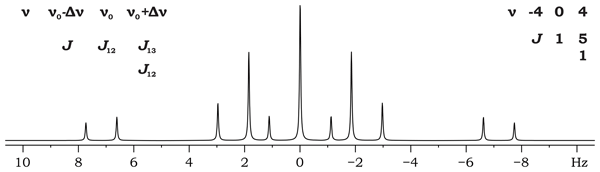
Figure 3Mirror-symmetric spectrum of ABC spin system.

Download

2 Theory

Figure 2 shows the spectra of two ABC spin systems with different signs of resonance frequencies. It is readily apparent that the spectra of these spin systems are mirror images of each other. Inverting the order of the resonance frequencies while maintaining the differences between them produces a reflected spectrum, which can be thought of as reversing the direction of the frequency axis.

To demonstrate how this spectral symmetry can be achieved for a single spin system, the parameter matrices of the considered ABC spin systems are rewritten below in the order of their resonance frequencies:

ν1ν2ν3-ν3-ν2-ν1984-4-8-9J12J13J23J131232J23J1231.

It can be shown that reversing the sequence of resonance frequencies results in a reflection of the J-coupling matrix about its anti-diagonal, while the coupling constants on the anti-diagonal itself remain unchanged. If, for a certain spin system, the parameter matrix is constructed in such a way that the resonance frequencies are symmetric about the mid-resonance frequency (ν0) and the J-coupling matrix is symmetric about the anti-diagonal, i.e., persymmetric (and thus bisymmetric) then reversing the order of the resonance frequencies will not alter the spectrum (Fig. 3). Moreover, the spectrum itself will be symmetric about ν0. Thus, a persymmetric J-coupling matrix remains invariant under a reversal of the spin order. The anti-diagonal itself contains the coupling constants between spin pairs that are interchanged upon order reversal, i.e., the first and the last, the second and the penultimate, and so forth. The resonance frequencies of these spin pairs must be symmetrically arranged about the mid-resonance frequency ν0; in other words, they must be “equilibrated”.

https://mr.copernicus.org/articles/7/15/2026/mr-7-15-2026-f04

Figure 4Some examples of theoretically calculated mirror-symmetric spectra for four, five, and six-spin systems.

Download

https://mr.copernicus.org/articles/7/15/2026/mr-7-15-2026-f05

Figure 5ODCB chemical structure with spin labeling, 1H NMR spectrum (300.13 MHz), and spin system matrices.

Download

3 Results and discussion

In Fig. 4, we present several theoretically calculated mirror-symmetric spectra for spin systems with different numbers of spins (four, five, and six). All of these spin systems possess parameter values that meet the conditions outlined above.

3.1 Spectral mirror symmetry of AAXX (AABB) and AnXn (AnBn) spin systems

It is well established that o-dichlorobenzene (ODCB) exhibits a mirror-symmetric 1H NMR spectrum, corresponding to an AAXX spin system (Fig. 5).

From the algebraic properties of the AAXX spin system Hamiltonian, it follows that the spectrum is independent of the signs of the differences within the coupling constant pairs {JAAJXX} and {JAXJAX}. Consequently, the spectrum is invariant under permutation of the values within these pairs. Crucially, interchanging JAA and JXX is equivalent to interchanging the resonance frequencies νA and νX. Since the spectrum is determined by two resonance frequencies and remains invariant under their permutation (i.e., the reversal of the resonance–frequency order), it must possess mirror symmetry.

The existence of three independent permutations within parameter pairs gives rise to eight distinct combinations of spin system parameters corresponding to the same NMR spectrum (Fig. 5). Four of these combinations can be represented as a result of spin reordering (Fig. 5a, c, f, h), while the others contain “non-physical” permutations of parameter values. Notably, none of these J-coupling matrices possess symmetry with respect to the anti-diagonal. However, the J-coupling matrix (Fig. 5b) is the anti-diagonal reflection of the matrix (Fig. 5a). This observation leads to more general criteria for mirror symmetry.

If the resonance frequencies are symmetric about the mid-resonance frequency (ν0) and if there exists a spin ordering in which resonance frequencies are monotonically ordered increasingly (or decreasingly) and if, in this order, the spectrum is invariant under the reflection of the J-coupling matrix about its anti-diagonal then the spectrum will be mirror-symmetric. Alternatively, the spectrum is mirror-symmetric if it is invariant under the reflection of all resonance frequencies about their mid-resonance frequency.

The coupling constants that map onto each other above and below the anti-diagonal can either be equal or form “balanced pairs” (actually, balance each other). In fact, in the AAXX (AABB) spin system, the constants JAA and JXX should be considered to be “equivalent” under anti-diagonal reflection. Therefore, when analyzing symmetric spin systems with chemically equivalent but magnetically non-equivalent spin groups, one must first identify all such balanced pairs of coupling constants and treat them as equivalent in assessing the symmetry of the J-coupling matrix.

Another family of mirror-symmetric spectra originates from spin systems with two groups of magnetically equivalent nuclei AnXn (AnBn), the mirror symmetry of which was proved by Corio (1966, p. 254). In general, the J-coupling matrix in such systems lacks persymmetry because the coupling constant between the A nuclei can differ from the coupling constant between the X (or B) nuclei. However, the theoretical spectrum is independent of coupling between magnetically equivalent nuclei. The spectrum depends only on the inter-group couplings, which are all equal to the same value JAX (JAB). Thus, the part of the J-coupling matrix that contains these coupling constants and defines the spectrum does indeed possess persymmetry.

https://mr.copernicus.org/articles/7/15/2026/mr-7-15-2026-f06

Figure 6Some examples of symmetric [AX]n ([AB]n) spin systems.

Download

3.2 Spectral asymmetry of some symmetric [AX]n ([AB]n) spin systems

Five representative examples of highly symmetric [AX]n spin systems are shown in Fig. 6. The condition of resonance frequency balance requires ordering spins by their resonance frequencies in ascending or descending order. However, within groups of chemically equivalent spins, an additional ordering is required. The chemical equivalence of spin groups, determined by spin permutation symmetry, results in the topological equivalence of the coupling networks of the [A]n and [X]n subsystems. Therefore, the most symmetric form of the J-coupling matrix can be achieved by a consistent ordering of chemically equivalent spins from different groups such that the equality JAX=JAX=JA′′X′′=JA′′′X′′′ holds. For 1,3,5-trifluorobenzene and the 1,3,5,7-tetrafluorosubstituted cyclooctatetraene dianion, this ordering coincides with the molecular canonical topological order. Accordingly, in all of the examples of J-coupling matrices presented in Fig. 6, the chemically equivalent spins were ordered using the described scheme.

In all considered spin systems, the J-coupling matrices exhibit high symmetry, with the inter-group coupling blocks being persymmetric. Unlike the AABB case, due to the algebraic properties of the Hamiltonian, there is no balancing of topologically equivalent homonuclear-coupling constant pairs in these systems. Specifically, the constant pairs {JAA, JXX}; {JAA′′, JXX′′}; and {JAA′′′, JXX′′′} do not form balanced pairs. Consequently, the spectra are not invariant under the permutation of constant values within these pairs or under the permutation of νA and νX and therefore do not possess mirror symmetry despite the high symmetry of the spin systems themselves.

Nevertheless, in the case of 1,3,5-trifluorobenzene, the high symmetry of the [AX]3 spin system results in symmetric signal patterns for the 1H(A) signal about νA and for the 19F(X) signal about νX separately.

4 Conclusions

The properties that a spin system must possess for its high-field NMR spectrum to be symmetric about the mid-resonance frequency ν0 have been identified. We believe that these findings are of fundamental importance to the theory of spin system spectra.

All theoretical spectra were simulated using the ANATOLIA NMR software (Cheshkov et al., 2018). For an in-depth theoretical analysis of spectral mirror symmetry, see Cheshkov and Sinitsyn (2026).

Code availability

The software used is publicly available (https://github.com/dcheshkov/ANATOLIA, Cheshkov et al., 2017).

Data availability

This is a theoretical paper; all the data are presented in the figures.

Author contributions

DAC and DOS contributed equally to the conceptualization, methodology, investigation, formal analysis, and writing (both original draft and review and editing) of this paper.

Competing interests

The contact author has declared that neither of the authors has any competing interests.

Disclaimer

Publisher's note: Copernicus Publications remains neutral with regard to jurisdictional claims made in the text, published maps, institutional affiliations, or any other geographical representation in this paper. The authors bear the ultimate responsibility for providing appropriate place names. Views expressed in the text are those of the authors and do not necessarily reflect the views of the publisher.

Acknowledgements

The authors thank Alexey S. Kiryutin for the helpful discussion.

Financial support

Publisher’s note: the article processing charges for this publication were not paid by a Russian or Belarusian institution.

Review statement

This paper was edited by Perunthiruthy Madhu and reviewed by Michael Tayler and Norbert Mueller.

References

Cheshkov, D. A. and Sinitsyn, D. O.: Total lineshape analysis of high-resolution NMR spectra, in: Annual Reports on NMR Spectroscopy, edited by: Webb, G. A., Academic Press, 100, 61–96, https://doi.org/10.1016/bs.arnmr.2019.11.001, 2020. 

Cheshkov, D. A., Sheberstov, K. F., Sinitsyn, D. O., and Chertkov, V. A.: ANATOLIA: Program for total lineshape analysis of NMR spectra, Github [code], https://github.com/dcheshkov/ANATOLIA (last access: 21 February 2026), 2017. 

Cheshkov, D. A. and Sinitsyn, D. O.: Mirror Symmetry of the NMR Spectrum and the Connection with the Structure of Spin Hamiltonian Matrix Representations, arXiv [preprint], https://doi.org/10.48550/arXiv.2602.03871, 2026. 

Cheshkov, D. A., Sheberstov, K. F., Sinitsyn, D. O., and Chertkov, V. A.: ANATOLIA: NMR software for spectral analysis of total lineshape, Magn. Reson. Chem., 56, 449–457, https://doi.org/10.1002/mrc.4689, 2018. 

Corio, P. L.: Structure of High-Resolution NMR spectra, Academic Press, ISBN 978-0124142831, 1966. 

Gunter, H.: NMR Spectroscopy: basic principles, concepts and applications in chemistry, 3rd Edn., Wiley-VCH, ISBN 978-3-527-33000-3, 2013. 

Hoffman, R. A., Forsen, S., and Gestblom, B.: Analysis of NMR spectra – A guide for chemists in NMR Basic Principles and Progress, edited by: Diehl, P., Fluck, E., and Kosfeld, R., Springer, Berlin, Heidelberg, N.Y., vol. 5, https://doi.org/10.1007/978-3-642-65205-9, 1971. 

Pople, J. A., Schneider, W. G., and Bernstein, H. J.: High Resolution Nuclear Magnetic Resonance, McGraw-Hill, ISBN 978-0070505162, 1959. 

Download
Short summary
This research reveals the hidden rules that connect the perfect mirror-image shape of a high-resolution nuclear magnetic resonance spectrum to the properties of a molecule's nuclear spin system. We found that this symmetry occurs only when specific, balanced conditions are met within the spin system. Testing these rules on various theoretical models confirmed their universal nature, providing a new framework for interpreting molecular symmetry from spectral patterns.
Share