Articles | Volume 6, issue 1
https://doi.org/10.5194/mr-6-43-2025
© Author(s) 2025. This work is distributed under
the Creative Commons Attribution 4.0 License.
Collection:
https://doi.org/10.5194/mr-6-43-2025
© Author(s) 2025. This work is distributed under
the Creative Commons Attribution 4.0 License.
Electron spin dynamics during microwave pulses studied by 94 GHz chirp and phase-modulated EPR experiments

Marvin Lenjer
CORRESPONDING AUTHOR
RG EPR Spectroscopy, Max Planck Institute for Multidisciplinary Sciences, Am Fassberg 11, 37077 Göttingen, Germany
Institute for Physical Chemistry, Georg August University Göttingen, Tammanstrasse 6, 37077 Göttingen, Germany
Nino Wili
Interdisciplinary Nanoscience Center, Aarhus University, Gustav Wieds Vej 14, 8000 Aarhus C, Denmark
Fabian Hecker
RG EPR Spectroscopy, Max Planck Institute for Multidisciplinary Sciences, Am Fassberg 11, 37077 Göttingen, Germany
Center for Hyperpolarization in Magnetic Resonance, Danish Technical University, Oerstedsplads 349, 2800 Kongens Lyngby, Denmark
Marina Bennati
RG EPR Spectroscopy, Max Planck Institute for Multidisciplinary Sciences, Am Fassberg 11, 37077 Göttingen, Germany
Institute for Physical Chemistry, Georg August University Göttingen, Tammanstrasse 6, 37077 Göttingen, Germany
Related authors
No articles found.
Julian Stropp, Nino Wili, Niels C. Nielsen, and Daniel Klose
Magn. Reson., 6, 33–42, https://doi.org/10.5194/mr-6-33-2025, https://doi.org/10.5194/mr-6-33-2025, 2025
Short summary
Short summary
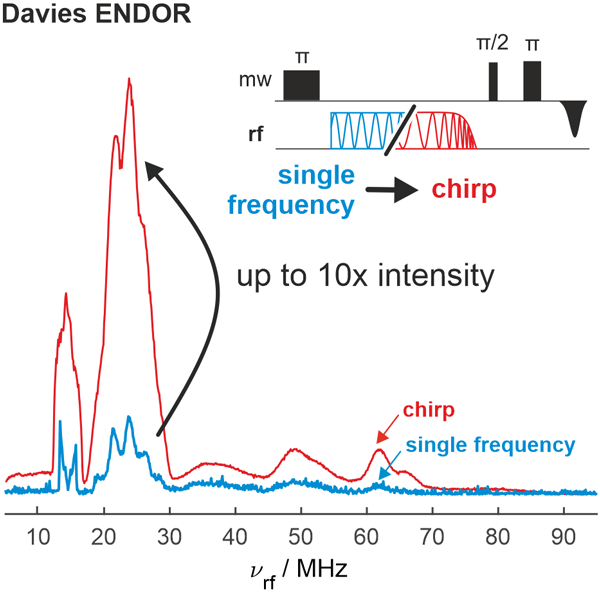
Sensitivity is often a limiting factor in electron–nuclear double resonance (ENDOR). Here we demonstrate how using chirp radiofrequency pulses can improve ENDOR sensitivity up to 3–9 fold, with the strongest increase for broader lines often encountered in disordered solids for nuclei such as nitrogen and metals. The resulting drastic speedup in acquisition times also renders 2D ENDOR more feasible, as we demonstrate in TRIPLE, showing correlations with Cu hyperfine couplings.
Gunnar Jeschke, Nino Wili, Yufei Wu, Sergei Kuzin, Hugo Karas, Henrik Hintz, and Adelheid Godt
Magn. Reson., 6, 15–32, https://doi.org/10.5194/mr-6-15-2025, https://doi.org/10.5194/mr-6-15-2025, 2025
Short summary
Short summary
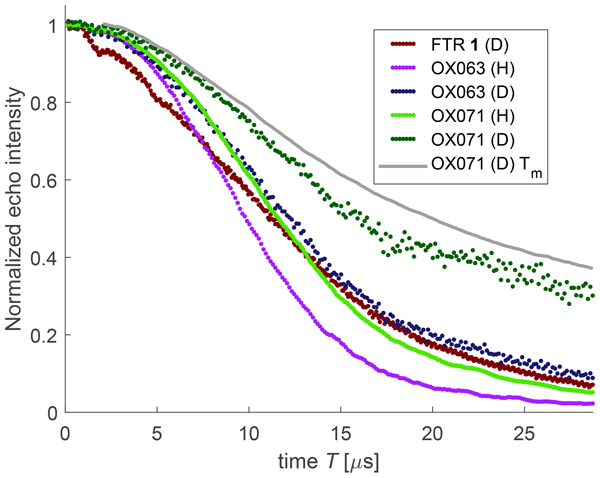
Electron spins sense their environment via magnetic interactions. An important contribution stems from nuclear spins in their vicinity. They cause loss of coherence and thus reduce resolution of spectra obtained by experiments on electron spins and the efficiency of transferring electron-spin magnetization to other nuclear spins. Here we study how protons in trityl radicals contribute to coherence loss. Such coherence loss is slower in the presence of a strong microwave field.
Nino Wili, Jan Henrik Ardenkjær-Larsen, and Gunnar Jeschke
Magn. Reson., 3, 161–168, https://doi.org/10.5194/mr-3-161-2022, https://doi.org/10.5194/mr-3-161-2022, 2022
Short summary
Short summary
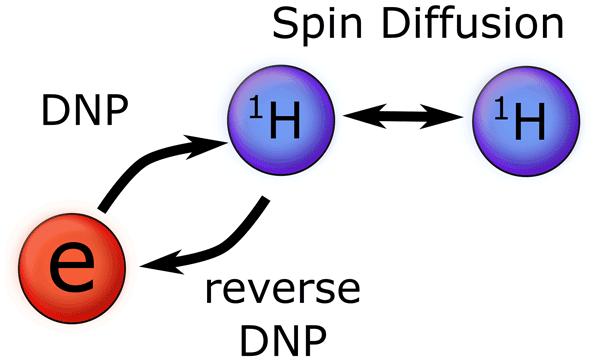
Dynamic nuclear polarisation (DNP) transfers polarisation from electron to nuclear spins. This is usually combined with direct detection of the latter. Here, we show that it is possible to reverse the transfer at 1.2 T. This allows us to investigate the spin dynamics of nuclear spins close to electrons – something that is notoriously difficult with established methods. We expect reverse DNP to be useful in the study of spin diffusion or as a building block for more elaborate pulse sequences.
Cited articles
Bahrenberg, T., Rosenski, Y., Carmieli, R., Zibzener, K., Qi, M., Frydman, V., Godt, A., Goldfarb, D., and Feintuch, A.: Improved sensitivity for W-band Gd (III)-Gd (III) and nitroxide-nitroxide DEER measurements with shaped pulses, J. Magn. Reson., 283, 1–13, https://doi.org/10.1016/j.jmr.2017.08.003, 2017. a, b
Baum, J., Tycko, R., and Pines, A.: Broadband and adiabatic inversion of a two-level system by phase-modulated pulses, Phys. Rev. A, 32, 3435, https://doi.org/10.1103/PhysRevA.32.3435, 1985. a, b
Bejenke, I.: Development and Application of CP-ENDOR Spectroscopy on Protein Radicals, Ph.D. thesis, Georg-August-Universität Göttingen, https://doi.org/10.53846/goediss-7891, 2020. a
Bloch, F.: Nuclear induction, Phys. Rev., 70, 460, https://doi.org/10.1103/PhysRev.70.460, 1946. a, b, c, d
Bodenhausen, G., Freeman, R., and Turner, D. L.: Suppression of artifacts in two-dimensional J spectroscopy, J. Magn. Reson., 27, 511–514, https://doi.org/10.1016/0022-2364(77)90016-6, 1977. a
Böhlen, J.-M., Rey, M., and Bodenhausen, G.: Refocusing with chirped pulses for broadband excitation without phase dispersion, J. Magn. Reson., 84, 191–197, https://doi.org/10.1016/0022-2364(89)90018-8, 1989. a, b
Cano, K. E., Smith, M. A., and Shaka, A.: Adjustable, broadband, selective excitation with uniform phase, J. Magn. Reson., 155, 131–139, https://doi.org/10.1006/jmre.2002.2506, 2002. a, b
Carr, H. Y. and Purcell, E. M.: Effects of diffusion on free precession in nuclear magnetic resonance experiments, Phys. Rev., 94, 630, https://doi.org/10.1103/PhysRev.94.630, 1954. a
Chen, H. Y. and Tycko, R.: Slice selection in low-temperature, DNP-enhanced magnetic resonance imaging by Lee-Goldburg spin-locking and phase modulation, J. Magn. Reson., 313, 106715, https://doi.org/10.1016/j.jmr.2020.106715, 2020. a
Cohen-Tannoudji, C. and Reynaud, S.: Dressed-atom description of resonance fluorescence and absorption spectra of a multi-level atom in an intense laser beam, J. Phys. B, 10, 345–363, https://doi.org/10.1088/0022-3700/10/3/005, 1977. a
Cox, N., Nalepa, A., Lubitz, W., and Savitsky, A.: ELDOR-detected NMR: A general and robust method for electron-nuclear hyperfine spectroscopy?, J. Magn. Reson., 280, 63–78, https://doi.org/10.1016/j.jmr.2017.04.006, 2017. a, b
De Luca, F., De Vita, E., Raza, G. H., and Casieri, C.: The spin coherence relaxation in the rotating frame as a microscopy parameter for strongly coupled spin systems, J. Magn. Reson., 139, 126–31, https://doi.org/10.1006/jmre.1999.1760, 1999. a
Desvaux, H., Berthault, P., Birlirakis, N., and Goldman, M.: Off-Resonance ROESY for the Study of Dynamic Processes, J. Magn. Reson., 108, 219–229, https://doi.org/10.1006/jmra.1994.1114, 1994. a, b
DeVoe, R. G. and Brewer, R. G.: Experimental test of the optical Bloch equations for solids, Phys. Rev. Lett., 50, 1269, https://doi.org/10.1103/PhysRevLett.50.1269, 1983. a
Doll, A. and Jeschke, G.: Wideband frequency-swept excitation in pulsed EPR spectroscopy, J. Magn. Reson., 280, 46–62, https://doi.org/10.1016/j.jmr.2017.01.004, 2017. a, b
Doll, A., Pribitzer, S., Tschaggelar, R., and Jeschke, G.: Adiabatic and fast passage ultra-wideband inversion in pulsed EPR, J. Magn. Reson., 230, 27–39, https://doi.org/10.1016/j.jmr.2013.01.002, 2013. a
Eckardt, A.: Colloquium: Atomic quantum gases in periodically driven optical lattices, Rev. Mod. Phys., 89, 011004, https://doi.org/10.1103/RevModPhys.89.011004, 2017. a
Ernst, M., Meier, B. H., Tomaselli, M., and Pines, A.: Time reversal of cross-polarization in solid-state NMR, Mol. Phys., 95, 849–858, https://doi.org/10.1080/002689798166477, 1998. a
Ernst, R. R., Bodenhausen, G., and Wokaun, A.: Principles of Nuclear Magnetic Resonance in One and Two Dimensions, Oxford University Press, ISBN 0198556470, 1987. a
Feintuch, A. and Vega, S.: Spin Dynamics, eMagRes, 6, 427–452, https://doi.org/10.1002/9780470034590.emrstm1506, 2017. a, b
Grzesiek, S. and Bax, A.: Audio-Frequency NMR in a Nutating Frame. Application to the Assignment of Phenylalanine Residues in Isotopically Enriched Proteins, J. Am. Chem. Soc., 117, 6527–6531, https://doi.org/10.1021/ja00129a016, 1995. a, b
Gyamfi, J. A.: Fundamentals of quantum mechanics in Liouville space, Eur. J. Phys., 41, 063002, https://doi.org/10.1088/1361-6404/ab9fdd, 2020. a
Hajduk, P. J., Horita, D. A., and Lerner, L. E.: Theoretical analysis of relaxation during shaped pulses, I. The effects of short T1 and T2, J. Magn. Reson., 103, 40–52, https://doi.org/10.1006/jmra.1993.1129, 1993. a
Henstra, A., Dirksen, P., Schmidt, J., and Wenckebach, W. T.: Nuclear spin orientation via electron spin locking (NOVEL), J. Magn. Reson., 77, 389–393, https://doi.org/10.1016/0022-2364(88)90190-4, 1988. a
Hovav, Y., Feintuch, A., and Vega, S.: Theoretical aspects of dynamic nuclear polarization in the solid state–the solid effect, J. Magn. Reson., 207, 176–189, https://doi.org/10.1016/j.jmr.2010.10.016, 2010. a, b
Hovav, Y., Kaminker, I., Shimon, D., Feintuch, A., Goldfarb, D., and Vega, S.: The electron depolarization during dynamic nuclear polarization: measurements and simulations, Phys. Chem. Chem. Phys., 17, 226–244, https://doi.org/10.1039/C4CP03825H, 2015. a, b
Jahn, S. M., Canarie, E. R., and Stoll, S.: Mechanism of Electron Spin Decoherence in a Partially Deuterated Glassy Matrix, J. Phys. Chem. Lett., 13, 5474–5479, https://doi.org/10.1021/acs.jpclett.2c00939, 2022. a
Jeschke, G.: Generation and transfer of coherence in electron-nuclear spin systems by non-ideal microwave pulses, Mol. Phys., 88, 355–383, https://doi.org/10.1080/00268979650026398, 1996. a
Jeschke, G.: Coherent superposition of dressed spin states and pulse dressed electron spin resonance, Chem. Phys. Lett., 301, 524–530, https://doi.org/10.1016/s0009-2614(99)00041-x, 1999. a, b
Jeschke, G. and Schweiger, A.: Hyperfine decoupling in electron spin resonance, J. Chem. Phys., 106, 9979–9991, https://doi.org/10.1063/1.474073, 1997. a
Jeschke, G., Pribitzer, S., and Doll, A.: Coherence transfer by passage pulses in electron paramagnetic resonance spectroscopy, J. Phys. Chem. B., 119, 13570–13582, https://doi.org/10.1021/acs.jpcb.5b02964, 2015. a, b, c, d
Jeschke, G., Wili, N., Wu, Y., Kuzin, S., Karas, H., Hintz, H., and Godt, A.: Electron-spin decoherence in trityl radicals in the absence and presence of microwave irradiation, Magn. Reson., 6, 15–32, https://doi.org/10.5194/mr-6-15-2025, 2025. a
Kaminker, I., Barnes, R., and Han, S.: Arbitrary waveform modulated pulse EPR at 200ĠHz, J. Magn. Reson., 279, 81–90, https://doi.org/10.1016/j.jmr.2017.04.016, 2017. a
Kupce, E. and Freeman, R.: Adiabatic pulses for wideband inversion and broadband decoupling, J. Magn. Reson., 115, 273–276, https://doi.org/10.1006/jmra.1995.1179, 1995. a, b, c
Kuprov, I.: Spin, Springer Nature Switzerland AG, ISBN 978-3-031-05606-2, 2023. a
Kuzhelev, A., Akhmetzyanov, D., Denysenkov, V., Shevelev, G., Krumkacheva, O., Bagryanskaya, E., and Prisner, T.: High-frequency pulsed electron–electron double resonance spectroscopy on DNA duplexes using trityl tags and shaped microwave pulses, Phys. Chem. Chem. Phys., 20, 26140–26144, https://doi.org/10.1039/C8CP03951H, 2018. a
Laucht, A., Simmons, S., Kalra, R., Tosi, G., Dehollain, J. P., Muhonen, J. T., Freer, S., Hudson, F. E., Itoh, K. M., Jamieson, D. N. McCallum, J. C., Dzurak, A. S., and Morello, A.: Breaking the rotating wave approximation for a strongly driven dressed single-electron spin, Phys. Rev. B, 94, 161302, https://doi.org/10.1103/PhysRevB.94.161302, 2016. a, b
Lenjer, M.: Electron spin dynamics during microwave pulses studied by 94 GHz chirp and phase-modulated EPR experiments, GRO.data [code and data set], https://doi.org/10.25625/B11CUC, 2024. a, b
Levitt, M. H.: Spin dynamics: basics of nuclear magnetic resonance, John Wiley & Sons Ltd., ISBN: 978-0-470-51118-3, 2013. a
Michaeli, S., Sorce, D. J., Idiyatullin, D., Ugurbil, K., and Garwood, M.: Transverse relaxation in the rotating frame induced by chemical exchange, J. Magn. Reson., 169, 293–9, https://doi.org/10.1016/j.jmr.2004.05.010, 2004. a, b
Mims, W., Nassau, K., and McGee, J.: Spectral diffusion in electron resonance lines, Phys. Rev., 123, 2059, https://doi.org/10.1103/PhysRev.123.2059, 1961. a
Nalepa, A., Möbius, K., Lubitz, W., and Savitsky, A.: High-field ELDOR-detected NMR study of a nitroxide radical in disordered solids: Towards characterization of heterogeneity of microenvironments in spin-labeled systems, J. Magn. Reson., 242, 203–213, https://doi.org/10.1016/j.jmr.2014.02.026, 2014. a, b, c
Pomplun, N., Heitmann, B., Khaneja, N., and Glaser, S.: Optimization of electron–nuclear polarization transfer, Appl. Magn. Reson., 34, 331–346, https://doi.org/10.1007/s00723-008-0124-6, 2008. a
Press, W. H., Teukolsky, S. A., Vetterling, W. T., and Flannery, B. P.: Numerical Recipes in C, vol. 2, Cambridge University Press, ISBN: 978-0-521-88068-8, 1992. a
Quan, Y., Subramanya, M. V., Ouyang, Y., Mardini, M., Dubroca, T., Hill, S., and Griffin, R. G.: Coherent Dynamic Nuclear Polarization using Chirped Pulses, J. Phys. Chem. Lett., 14, 4748–4753, https://doi.org/10.1021/acs.jpclett.3c00726, 2023. a
Redfield, A. G.: Nuclear magnetic resonance saturation and rotary saturation in solids, Phys. Rev., 98, 1787, https://doi.org/10.1103/PhysRev.98.1787, 1955. a
Rizzato, R., Kaminker, I., Vega, S., and Bennati, M.: Cross-polarisation edited ENDOR, Mol. Phys., 111, 2809–2823, https://doi.org/10.1080/00268976.2013.816795, 2013. a, b
Rizzato, R., Schalk, M., Mohr, S., Hermann, J. C., Leibold, J. P., Bruckmaier, F., Salvitti, G., Qian, C., Ji, P., Astakhov, G. V., et al.: Extending the coherence of spin defects in hBN enables advanced qubit control and quantum sensing, Nat. Commun., 14, 5089, https://doi.org/10.1038/s41467-023-40473-w, 2023. a
Schenzle, A., Mitsunaga, M., DeVoe, R., and Brewer, R.: Microscopic theory of optical line narrowing of a coherently driven solid, Phys. Rev. A, 30, 325, https://doi.org/10.1103/PhysRevA.30.325, 1984. a
Schosseler, P., Wacker, T., and Schweiger, A.: Pulsed ELDOR detected NMR, Chem. Phys. Lett., 224, 319–324, https://doi.org/10.1016/0009-2614(94)00548-6, 1994. a
Slichter, C. P.: Principles of magnetic resonance, Vol. 1, Springer-Verlag Berlin Heidelberg, ISBN: 978-3-662-09441-9, 1990. a
Soetbeer, J., Ibanez, L. F., Berkson, Z., Polyhach, Y., and Jeschke, G.: Regularized dynamical decoupling noise spectroscopy – a decoherence descriptor for radicals in glassy matrices, Phys. Chem. Chem. Phys., 23, 21664–21676, https://doi.org/10.1039/d1cp03103a, 2021. a, b
Spindler, P. E., Schöps, P., Bowen, A. M., Endeward, B., and Prisner, T. F.: Shaped pulses in EPR, eMagRes, 5, 1477–1492, https://doi.org/10.1002/9780470034590.emrstm1520, 2016. a
Stoll, S. and Schweiger, A.: EasySpin, a comprehensive software package for spectral simulation and analysis in EPR, J. Magn. Reson., 178, 42–55, https://doi.org/10.1016/j.jmr.2005.08.013, 2006. a, b
Subramanya, M. V. H., Marbey, J., Kundu, K., McKay, J. E., and Hill, S.: Broadband Fourier-Transform-Detected EPR at W-Band, Appl. Magn. Reson., 54, 165–181, https://doi.org/10.1007/s00723-022-01499-3, 2022. a
Tait, C. E. and Stoll, S.: ENDOR with band-selective shaped inversion pulses, J. Magn. Reson., 277, 36–44, https://doi.org/10.1016/j.jmr.2017.02.007, 2017. a
Torrey, H.: Transient nutations in nuclear magnetic resonance, Phys. Rev., 76, 1059, https://doi.org/10.1103/PhysRev.76.1059, 1949. a
Weis, V. and Griffin, R.: Electron-nuclear cross polarization, Solid State Nucl. Magn. Reson., 29, 66–78, https://doi.org/10.1016/j.ssnmr.2005.08.005, 2006. a
Weis, V., Bennati, M., Rosay, M., Bryant, J., and Griffin, R.: High-field DNP and ENDOR with a novel multiple-frequency resonance structure, J. Magn. Reson., 140, 293–299, https://doi.org/10.1006/jmre.1999.1841, 1999. a
Weis, V., Bennati, M., Rosay, M., and Griffin, R. G.: Solid effect in the electron spin dressed state: A new approach for dynamic nuclear polarization, J. Chem. Phys., 113, 6795–6802, https://doi.org/10.1063/1.1310599, 2000. a, b
Wili, N. and Jeschke, G.: Chirp echo Fourier transform EPR-detected NMR, J. Magn. Reson., 289, 26–34, https://doi.org/10.1016/j.jmr.2018.02.001, 2018. a, b, c, d
Zhao, Y., El Mkami, H., Hunter, R. I., Casano, G., Ouari, O., and Smith, G. M.: Large cross-effect dynamic nuclear polarisation enhancements with kilowatt inverting chirped pulses at 94 GHz, Commun. Chem., 6, 171, https://doi.org/10.1038/s42004-023-00963-w, 2023. a
Short summary
Electron spin dynamics during microwave irradiation are of increasing interest in electron paramagnetic resonance (EPR) spectroscopy. Here, we show that these dynamics can be probed by modern pulsed EPR experiments that use shaped microwave pulses. Combined with spin dynamics simulations, these results provide a starting point for optimizing existing EPR experiments and for developing new pulse sequences.
Electron spin dynamics during microwave irradiation are of increasing interest in electron...
Collection