Articles | Volume 3, issue 2
https://doi.org/10.5194/mr-3-111-2022
© Author(s) 2022. This work is distributed under
the Creative Commons Attribution 4.0 License.
https://doi.org/10.5194/mr-3-111-2022
© Author(s) 2022. This work is distributed under
the Creative Commons Attribution 4.0 License.
Insight into the structure of black coatings of ancient Egyptian mummies by advanced electron magnetic resonance of vanadyl complexes
Charles E. Dutoit
Chimie-ParisTech, PSL University, CNRS, Institut de Recherche de
Chimie-Paris (IRCP), 75005 Paris, France
Laurent Binet
Chimie-ParisTech, PSL University, CNRS, Institut de Recherche de
Chimie-Paris (IRCP), 75005 Paris, France
Hervé Vezin
Université de Lille, CNRS, UMR8516-LASIRE, 59000 Lille, France
Océane Anduze
Chimie-ParisTech, PSL University, CNRS, Institut de Recherche de
Chimie-Paris (IRCP), 75005 Paris, France
Agnès Lattuati-Derieux
Centre de Recherche et de Restauration des Musées de France
(C2RMF), Palais du Louvre, 75001 Paris, France
Didier Gourier
CORRESPONDING AUTHOR
Chimie-ParisTech, PSL University, CNRS, Institut de Recherche de
Chimie-Paris (IRCP), 75005 Paris, France
Related authors
No articles found.
Charles-Emmanuel Dutoit, Raffaella Soleti, Jean-Marie Doux, Vincent Pelé, Véronique Boireau, Christian Jordy, Simon Pondaven, and Hervé Vezin
Magn. Reson., 6, 113–118, https://doi.org/10.5194/mr-6-113-2025, https://doi.org/10.5194/mr-6-113-2025, 2025
Short summary
Short summary
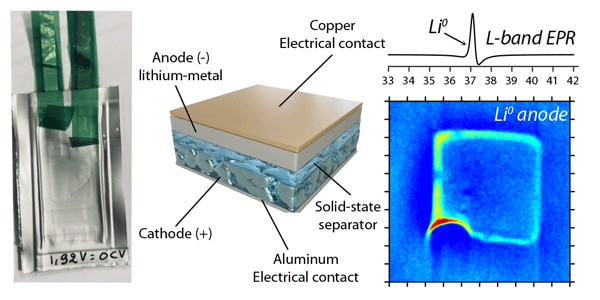
We have performed a low-frequency electron paramagnetic resonance (EPR) study on two (LiNi0.8Mn0.1Co0.1O2 (NMC)-Li-metal- and NMC-Si-based) solid-state batteries sealed inside an industrial and standard aluminum laminated pouch cell. We observed an EPR spectrum from Li metal, confirming the good penetration of the microwave field through the pouch. We think our approach provides valuable insight for the battery community, paving the way for the quality control of industrial and commercial batteries.
Charles-E. Dutoit, Hania Ahouari, Quentin Denoyelle, Simon Pondaven, and Hervé Vezin
Magn. Reson., 5, 87–93, https://doi.org/10.5194/mr-5-87-2024, https://doi.org/10.5194/mr-5-87-2024, 2024
Short summary
Short summary
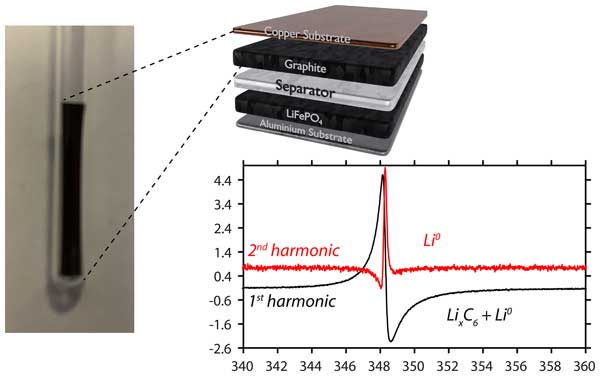
In our study, we correlate the first- and the second-harmonic detection modes of continuous-wave electron paramagnetic resonance (EPR) to identify traces of non-dendritic Li metal present on the graphite anode after multiple electrochemical cycles. Such metallic complexes are a source of limitations which reduce battery life and lead to serious safety issues. To improve their detection, we propose to simultaneously record the first- and second-harmonic EPR spectra.
Elise Garel, Laurent Binet, and Didier Gourier
Magn. Reson., 3, 211–220, https://doi.org/10.5194/mr-3-211-2022, https://doi.org/10.5194/mr-3-211-2022, 2022
Short summary
Short summary
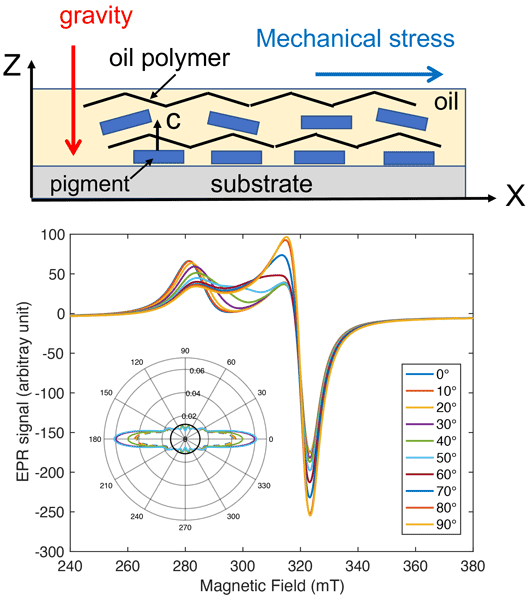
Could the gesture of an ancient artist applying a paint layer be reconstructed using EPR analysis? In the case of an inorganic pigment widely used in antiquity, Egyptian blue, where the anisotropy of the Cu2+ EPR signal reflects the symmetry of the pigment crystallites, we have shown that the orientation distribution of the grains, as revealed by simulation of EPR spectra, is indeed influenced by the nature of the gesture.
Benjamin Nicot, Jean-Pierre Korb, Isabelle Jolivet, Hervé Vezin, Didier Gourier, and Anne-Laure Rollet
Magn. Reson., 3, 125–136, https://doi.org/10.5194/mr-3-125-2022, https://doi.org/10.5194/mr-3-125-2022, 2022
Short summary
Short summary
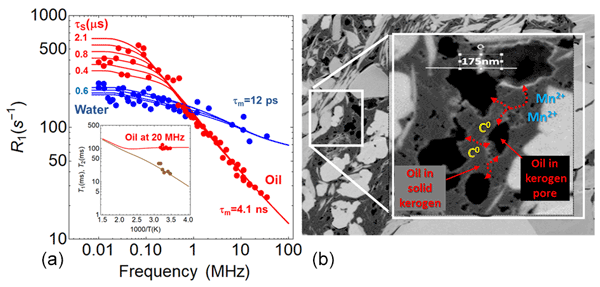
In this article we report a multiscale approach for explaining why the transport of fluids in oil shales is so hindered. Thanks to nuclear and electronic magnetic resonances, we first demonstrate that the kerogen within the shale is capable of swelling in the presence of oil; and second we show that this swelling is reversible and reveals the presence of vanadyl porphyrin by breaking magnetic interaction. The magnetic interactions evidenced helps understand the very low mobility of hydrocarbons.
Cited articles
Aizenshtat, Z. and Sundararaman, P.: Maturation trend in oils and asphalts
of the Jordan Rift – Utilization of detailed vanadylporphyrin analysis.
Geochim. Cosmochim. Acta. 53, 3185–3188, https://doi.org/10.1016/0016-7037(89)90098-7, 1989.
Baker, E. W. and Louda, J. W.: In Biological Markers in the Sedimentary
Record, edited by: John, R. B., Elsevier, Amsterdam, Netherlands, 125–225, 1986.
Barwise, A. J. G.:, Role of Nickel and Vanadium in Petroleum Classification,
Energy Fuels, 4, 647–652, https://doi.org/10.1021/ef00024a005,1990.
Ben Tayeb, K., Delpoux, O., Barbier, J., Marques, J., Verstraete, J., and
Vezin, H.: Applications of pulsed electron paramagnetic resonance
spectroscopy to the identification of vanadyl complexes in asphaltene
molecules. Part 1: Influence of the origin of the feed, Energy Fuels, 29,
4608–4615, https://doi.org/10.1021/acs.energyfuels.5b00733,
2015.
Bertrand, P.: Electron Paramagnetic Resonance Spectroscopy: Fundamentals, UGA Edition,
Springer, Grenoble, 444 pp., ISBN 978-3030396626, 2020.
Biktagirov, T., Gafurov, M., Mamin, G., Gracheva, I., Galukhin, A., and
Orlinskii, S.: In situ identification of various structural features of vanadyl
porphyrins in crude oil by high-field (3.4 T) Electron-Nuclear Double
Resonance spectroscopy combined with Density Functional Theory calculations,
Energy Fuels, 31, 1243–1249, https://doi.org/10.1021/acs.energyfuels.6b02494, 2017.
Binet, L., Gourier, D., Derenne, S., and Robert, F.: Heterogeneous
distribution of paramagnetic radicals in insoluble organic matter from the
Orgueil and Murchison meteorites, Geochim. Cosmochim. Acta, 66, 4177–4186,
https://doi.org/10.1016/S0016-7037(02)00983-3, 2002.
Bourbin, M., Gourier, D., Derenne, S., Binet, L., Le Du, Y., Westall, F.,
Kremer, B., and Gautret, P.: Dating carbonaceous matter in Archean cherts by
Electron paramagnetic resonance, Astrobiology, 13, 151–162, https://doi.org/10.1089/ast.2012.0855, 2013.
Breit, G. N. and Wanty, R. B.: Vanadium accumulation in carbonaceous rocks: A
review of geochemical controls during deposition and diagenesis, Chem.
Geol., 91, 83–97, https://doi.org/10.1016/0009-2541(91)90083-4, 1991.
Buckley, S. A. and Evershed, R. P.: Organic chemistry of embalming agents in
Pharaonic and Graeco-Roman mummies, Nature, 413, 837–841, https://doi.org/10.1038/35101588, 2001.
Buckley, S. A., Clark, K. A., and Evershed, R. P.: Complex organic chemical
balms of Pharaonic animal mummies, Nature 43, 294–298, https://doi.org/10.1038/nature02849, 2004.
Clark, K. A., Ikram, S., and Evershed, R. P.: The significance of petroleum in
ancient Egyptian mummies, Philos. Trans. R. Soc. A, 374, 20160229, https://doi.org/10.1098/rsta.2016.0229, 2016.
Colombini, M. P., Modugno, F., Silvano, F., and Onor, M.: Characterization of
the balm of an Egyptian mummy from the seventh century B.C. Studies in
Conservation, 45, 19–29, https://doi.org/10.2307/1506680,
2000.
Connan, J., and Dessort, D.: Dead-Sea asphalt in the balms of an egyptian
mummy – Identification by molecular criteria, C.R. Acad. Sci. Paris, 309,
1665–1672, 1989.
Davis, E.: Mummy mania, Chem. World, 8, 48–51, 2011.
Dechaine, G. P. and Gray, M. R.: Chemistry and association of vanadium
compounds in heavy oil and bitumen, and implications for their selective
removal, Energy Fuels, 24, 2795–2808, https://doi.org/10.1021/ef100173j, 2010.
Dikanov, S. A., Xun, L., Karpiel, A. B., Tyryshkin, A. M., and Bowman, M. K.:
Orientationally-selected two-dimensional ESEEM spectroscopy of the
Rieske-type iron-sulfur cluster in 2,4,5-Trochlorophenoxyacetate
monooxygenase from Burkholderia cepaia AC1100, J. Am. Chem. Soc., 118, 8408–8416, https://doi.org/10.1021/ja960781x, 1996.
Dikanov, S. A., Shubin, A. A., Kounosu, A., Iwasaki, T., and Samoilova, R. I.:
A comparative, two-dimensional 14N ESEEM characterization of reduced
[2Fe-2S] clusters in hyperthermophilic archaeal high- and low-potential Rieske-type proteins, J. Biol. Inorg.
Chem., 9, 753–767, https://doi.org/10.1007/s00775-004-0571-y,
2004.
Dutoit, C. E.: Hyscore_Endor_Balm, V1, Mendeley Data [data set], https://doi.org/10.17632/bnb9jsjs5r.1, 2022.
Dutoit, C. E., Binet, L., Fujii, H., Lattuati-Derieux, A., and Gourier, D.:
Nondestructive Analysis of Mummication Balms in Ancient Egypt Based on EPR
of Vanadyl and Organic Radical Markers of Bitumen, Anal. Chem. 92,
15445–15453, https://doi.org/10.1021/acs.analchem.0c03116,
2020.
Fukui, K., Ohya-Nishiguchi, H., and Kamada, H.: Electron Spin Echo Envelope
Modulation Study on Oxovanadium(IV)-Porphyrin Complexes: Reinvestigation of
Hyperfine and Quadrupole Couplings of Pyrrole Nitrogen, J. Phys. Chem., 97,
11858–11860, https://doi.org/10.1021/j100148a002, 1993.
Fulcher, K., Serpico, M., Taylor, J. H., and Stacey, R.: Molecular analysis
of black coatings and anointing fluids from ancient Egyptian coffins, mummy
cases and funerary objects, P. Natl. Acad. Sci. USA, 118, 1–10,
https://doi.org/10.1073/pnas.2100885118, 2021.
Garcia-Rubio, I., Martinez, J. I., Picorel, R., Yruela, I., and Alonso, P. J.:
HYSCORE spectroscopy in the Cytochrome b559 of the photosystem II
reaction center, J. Am. Chem. Soc., 125, 15846–15854, https://doi.org/10.1021/ja035364g, 2003.
Gourier, D., Delpoux, O., Skzypczak-Bonduelle, O., Binet, L., Ciofini, I.,
and Vezin, H.: EPR, ENDOR and HYSCORE study of the structure and the
stability of vanadyl-porphyrin complexes encapsulated in silica: Potential
paramagnetic biomarkers for the origin of life, J. Phys. Chem., 114,
3714–3725, https://doi.org/10.1021/jp911728e, 2010.
Gracheva, I. N., Gafurov, M. R., Mamin, G. V., Biktagirov, T. B., Rodionov,
A. A., Galukhin, A. V., and Orlinskii, S. B.: ENDOR study of nitrogen hyperfine
and quadrupolar tensors in vanadyl porphyrins of heavy crude oil, Magn.
Reson. in Solids, 18, 16102, 2016.
Harrell, J. A. and Lewan, M. D.: Sources of mummy bitumen in ancient Egypt,
Archaeometry, 44, 285–293, https://doi.org/10.1111/1475-4754.t01-1-00060, 2002.
Karlik, S. J., Bartha, R., Kennedy, K., and Chhem, R.: MRI and Multinuclear MR Spectroscopy of 3,200 Year-Old Egyptian Mummy Brain,
Am. J. Roentgenol., 189, 105–110,
https://doi.org/10.2214/AJR.07.2087, 2007.
Kevan, L. and Kispert, L. D.: In Electron Spin Double Resonance
Spectroscopy, John Wiley & Sons, New York, 239–251, 1976.
Lopez, L. and Lo Monaco, S.: Vanadium, nickel and sulfur in crude oils and
source rocks and their relationship with biomarkers: Implication for the
origin of crude oils in Venezuelan basins, Org. Geochem., 104, 53–68,
https://doi.org/10.1016/j.orggeochem.2016.11.007, 2017.
Lucas, A. and Harris, J. R.: Ancient Egyptian Materials and Industries,
Histories and Mysteries of Man, Ltd London, IVth ed., 523 p., 1989.
Lucejko, J., Connan, J., Orsini, S., Ribechini, E., and Modugno, F.:
Chemical analyses of Egyptian mummification balms and organic residues from
storage jars dated from the Old Kingdom to the Copto-Byzantine period. J.
Archeol. Sci., 85, 1–12, https://doi.org/10.1016/j.jas.2017.06.015, 2017.
Mamin, G. V., Gafurov, M. R., Yusupov, R. V., Gracheva, I. N., Ganeeva, Yu. M.,
Yusupova, T. N., and Orlinskii, S. B.: Towards the asphaltene structure by
electron paramagnetic relaxation studies at high fields (3.4 T), Energy
Fuels, 30, 6942–6946, https://doi.org/10.1021/acs.energyfuels.6b00983, 2016.
Mannikko, D. and Stoll, S.: Vanadyl porphyrin speciation based on
submegahertz ligand proton hyperfine couplings, Energy Fuels, 33, 4237–4243,
https://doi.org/10.1021/acs.energyfuels.9b00867, 2019.
Maurer, J., Möhring, T., Rullkötter, J., and Nissenbaum, A.: Plant
lipids and fossil hydrocarbons in embalming material of Roman Period mummies
from the Dakhleh Oasis, Western Desert, Egypt. J. Arch. Sci., 29, 751–762,
https://doi.org/10.1006/jasc.2001.0773, 2002.
Moons, H., Patel, H. H., Gorun, S. M., and Van Doorslaer, S.: Electron paramagnetic resonance and DFT analysis of the effect of bulky
perfluoroalkyl substituents on a vanadyl perfluoro phtalocyanine, Z. Phys.
Chem., 231, 887–903, https://doi.org/10.1515/zpch-2016-0827,
2017
Mullins, O. C.: The modified Yen model, Energy Fuels, 24, 2179–2207,
https://doi.org/10.1021/ef900975e, 2010.
Mûnnemann, K., Bôni, T., Colacicco, G., Blûmich, B., and
Rûhli, F. J.: Noninvasive 1H and 23Na nuclear resonance imaging
of ancient Egyptian human mummified tissue, Magn. Reson. Imaging, 25,
1341–1345, https://doi.org/10.1016/j.mri.2007.03.023, 2007.
Özen, A. C., Ludwig, U., Öhrström, L. M., and Rûhli, F. J.:
Comparison of Ultrashort Echo Time Sequences for MRI of an Ancient Mummified
Human Hand, Magn. Reson. Med., 75, 701–708, https://doi.org/10.1002/mrm.25651, 2016.
Premovic, P. I., Tonsa, I. R., Pavlovic, M. S., Lopez, L., and Lo Monaco, S.:
Classification of the asphalts and their source rocks from the Dead Sea
Basin, Fuel, 77, 1769–1776, https://doi.org/10.1016/S0016-2361(98)00100-8, 1998.
Reijerse, E. J., Tyryshkin, A. M., and Dikanov, S. A.: Complete determination
of nitrogen quadrupole and hyperfine tensors in an oxovanadium complex by
simultaneous fitting of multifrequency ESEEM powder spectra, J. Magn.
Reson., 131, 295–309, https://doi.org/10.1006/jmre.1997.1339,
1998.
Rullkötter, J., Spiro, B., and Nissenbaum, A.: Biological marker
characteristics of oils and asphalts from carbonate source rocks in a
rapidly subsiding graben, Dead Sea, Israel, Geochim. Cosmochim. Acta, 49,
1357–1370, https://doi.org/10.1016/0016-7037(85)90286-8, 1985.
Rullkötter, J. and Nissenbaum, A.: Dead Sea asphalt in Egyptian mummies:
molecular evidence, Naturewissenschaften, 75, 618–621, https://doi.org/10.1007/BF00366476, 1988.
Saraceno, A. J., Coggeshall, N. D., and Fanale, D. T.: An electron paramagnetic
resonance investigation of vanadium in petroleum oils, Anal. Chem., 33,
500–505, https://doi.org/10.1021/ac60172a009, 1961.
Schweiger, A. and Jeschke, G.: Principles of Pulse Electron Paramagnetic
Resonance, Oxford University Press, Oxford, 578 pp., ISBN 0-19-850634-1, 2001.
Skrzypczak-Bonduelle, A., Binet, L., Delpoux, O., Vezin, H., Derenne, S.,
Robert, F., and Gourier, D.: EPR of organic radicals in primitive organic
matter : A tool for the search of biosignatures of the most ancient traces
of life, Appl. Magn. Reson., 33, 371–397, https://doi.org/10.1007/s00723-008-0083-y, 2008.
Spielmann, P. E.: To what extent did the ancient Egyptian employ bitumen for
embalming, J. Egypt. Archeol., 18, 177–180, 1933.
Stoll, S. and Schweiger, A.: EasySpin, a comprehensive software package for
spectral simulation and analysis in EPR, J. Magn. Reson., 178, 42–55,
https://doi.org/10.1016/j.jmr.2005.08.013, 2006 (code available at: https://www.easyspin.org/download.html, last access: 15 June 2022).
Stoll, S., Calle, C., Mitrikas, G., and Schweiger, A.: Peak suppression in
ESEEM spectra of multinuclear spin systems, J. Magn. Reson., 177, 93–101,
https://doi.org/10.1016/j.jmr.2005.07.012, 2005.
Uebersfeld, J., Etienne, A., and Combrisson, J.: Paramagnetic resonance, a
new property of coal-like materials. Nature, 174, 614, https://doi.org/10.1038/174614a0, 1954.
Short summary
Egyptian mummies were covered with an enigmatic black organic matter. Its chemical composition is classically determined by molecular analysis methods, which are destructive by nature. In a new analytical approach based on 1H and 14N hyperfine spectroscopy, we use V+ ions, existing at trace level in this black matter, as internal probes for a non-destructive exploration of the material. The results suggest that a common recipe was used for animal and human mummies of different ages.
Egyptian mummies were covered with an enigmatic black organic matter. Its chemical composition...