Articles | Volume 5, issue 1
https://doi.org/10.5194/mr-5-87-2024
© Author(s) 2024. This work is distributed under
the Creative Commons Attribution 4.0 License.
https://doi.org/10.5194/mr-5-87-2024
© Author(s) 2024. This work is distributed under
the Creative Commons Attribution 4.0 License.
Second-harmonic electron paramagnetic resonance spectroscopy and imaging reveal metallic lithium depositions in Li-ion batteries

Charles-E. Dutoit
CORRESPONDING AUTHOR
Université Lille Nord de France, CNRS, UMR8516, LASIRE, 59655 Villeneuve d'Ascq, France
Centre de Résonance Magnétique Electronique pour les Matériaux et l'Energie, Université Lille Nord de France, 59655 Villeneuve d'Ascq, France
Hania Ahouari
Université Lille Nord de France, CNRS, UMR8516, LASIRE, 59655 Villeneuve d'Ascq, France
Université de Lille, FR2638, IMEC, Institut Michel-Eugène Chevreul, 59655 Villeneuve d'Ascq, France
Quentin Denoyelle
SAFT, Corporate Research, 111 Boulevard Alfred Dancy, 33074 Bordeaux, France
Simon Pondaven
Centre de Résonance Magnétique Electronique pour les Matériaux et l'Energie, Université Lille Nord de France, 59655 Villeneuve d'Ascq, France
TotalEnergies OneTech R&D, Centre de Recherche de Solaize (CRES), Chemin du Canal, BP 22, 69360 Solaize, France
Hervé Vezin
Université Lille Nord de France, CNRS, UMR8516, LASIRE, 59655 Villeneuve d'Ascq, France
Centre de Résonance Magnétique Electronique pour les Matériaux et l'Energie, Université Lille Nord de France, 59655 Villeneuve d'Ascq, France
Related authors
Charles-Emmanuel Dutoit, Raffaella Soleti, Jean-Marie Doux, Vincent Pelé, Véronique Boireau, Christian Jordy, Simon Pondaven, and Hervé Vezin
Magn. Reson., 6, 113–118, https://doi.org/10.5194/mr-6-113-2025, https://doi.org/10.5194/mr-6-113-2025, 2025
Short summary
Short summary
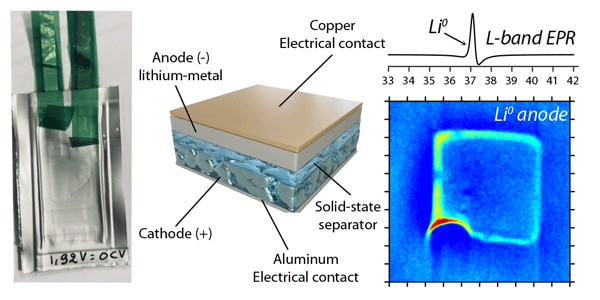
We have performed a low-frequency electron paramagnetic resonance (EPR) study on two (LiNi0.8Mn0.1Co0.1O2 (NMC)-Li-metal- and NMC-Si-based) solid-state batteries sealed inside an industrial and standard aluminum laminated pouch cell. We observed an EPR spectrum from Li metal, confirming the good penetration of the microwave field through the pouch. We think our approach provides valuable insight for the battery community, paving the way for the quality control of industrial and commercial batteries.
Charles-Emmanuel Dutoit, Raffaella Soleti, Jean-Marie Doux, Vincent Pelé, Véronique Boireau, Christian Jordy, Simon Pondaven, and Hervé Vezin
Magn. Reson., 6, 113–118, https://doi.org/10.5194/mr-6-113-2025, https://doi.org/10.5194/mr-6-113-2025, 2025
Short summary
Short summary
We have performed a low-frequency electron paramagnetic resonance (EPR) study on two (LiNi0.8Mn0.1Co0.1O2 (NMC)-Li-metal- and NMC-Si-based) solid-state batteries sealed inside an industrial and standard aluminum laminated pouch cell. We observed an EPR spectrum from Li metal, confirming the good penetration of the microwave field through the pouch. We think our approach provides valuable insight for the battery community, paving the way for the quality control of industrial and commercial batteries.
Benjamin Nicot, Jean-Pierre Korb, Isabelle Jolivet, Hervé Vezin, Didier Gourier, and Anne-Laure Rollet
Magn. Reson., 3, 125–136, https://doi.org/10.5194/mr-3-125-2022, https://doi.org/10.5194/mr-3-125-2022, 2022
Short summary
Short summary
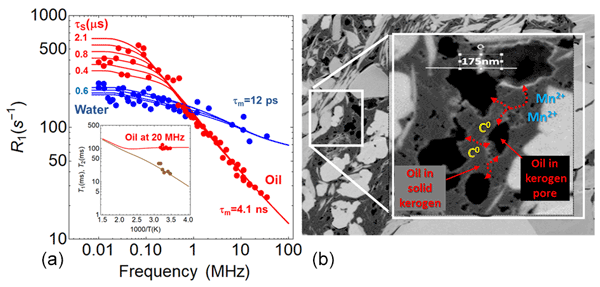
In this article we report a multiscale approach for explaining why the transport of fluids in oil shales is so hindered. Thanks to nuclear and electronic magnetic resonances, we first demonstrate that the kerogen within the shale is capable of swelling in the presence of oil; and second we show that this swelling is reversible and reveals the presence of vanadyl porphyrin by breaking magnetic interaction. The magnetic interactions evidenced helps understand the very low mobility of hydrocarbons.
Charles E. Dutoit, Laurent Binet, Hervé Vezin, Océane Anduze, Agnès Lattuati-Derieux, and Didier Gourier
Magn. Reson., 3, 111–124, https://doi.org/10.5194/mr-3-111-2022, https://doi.org/10.5194/mr-3-111-2022, 2022
Short summary
Short summary
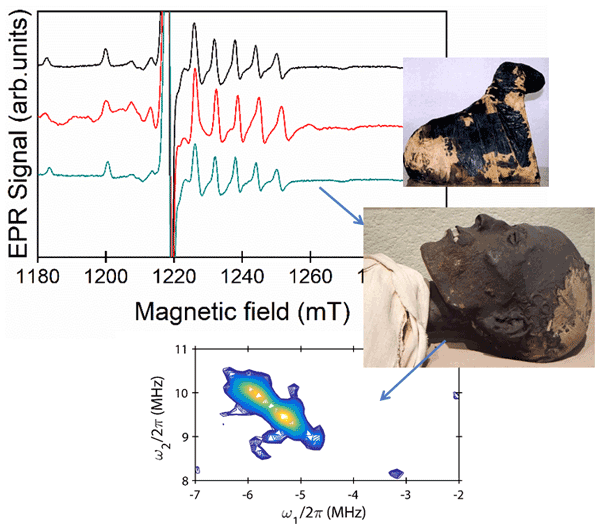
Egyptian mummies were covered with an enigmatic black organic matter. Its chemical composition is classically determined by molecular analysis methods, which are destructive by nature. In a new analytical approach based on 1H and 14N hyperfine spectroscopy, we use V+ ions, existing at trace level in this black matter, as internal probes for a non-destructive exploration of the material. The results suggest that a common recipe was used for animal and human mummies of different ages.
Cited articles
Armand, M. and Tarascon, J.: Building better batteries, Nature, 451, 2–7, 2008. a
Bhattacharyya, R., Key, B., Chen, H., Best, A. S., Hollenkamp, A. F., and Grey, C. P.: In situ NMR observation of the formation of metallic lithium microstructures in lithium batteries, Nat. Mater., 9, 504–510, https://doi.org/10.1038/nmat2764, 2010. a
Chandrashekar, S., Trease, N. M., Chang, H. J., Du, L.-S., Grey, C. P., and Jerschow, A.: Li MRI of Li batteries reveals location of microstructural lithium, Nat. Mater., 11, 311–315, https://doi.org/10.1038/nmat3246, 2012. a
Dutoit, C.-E.: Second harmonic EPR spectroscopy and imaging reveal Li-metal depositions in Li-ion batteries, Zenodo [data set], https://doi.org/10.5281/zenodo.10623150, 2024. a
Dutoit, C. E., Tang, M., Gourier, D., Tarascon, J. M., Vezin, H., and Salager, E.: Monitoring metallic sub-micrometric lithium structures in Li-ion batteries by in situ electron paramagnetic resonance correlated spectroscopy and imaging, Nat. Commun., 12, 1–6, https://doi.org/10.1038/s41467-021-21598-2, 2021. a, b, c
Dyson, F. J.: Electron spin resonance absorption in metals. I. Experimental, Phys. Rev., 98, 349–359, 1955. a
Fang, Y., Smith, A. J., Lindström, R. W., Lindbergh, G., and Furó, I.: Quantifying lithium lost to plating and formation of the solid-electrolyte interphase in graphite and commercial battery components, Applied Materials Today, 28, 101527, https://doi.org/10.1016/j.apmt.2022.101527, 2022. a
Feher, G. and Kip, A. F.: Electron Spin Resonance Absorption in Metals. I. Experimental, Phys. Rev. B, 98, 337–348, 1955. a
Finegan, D. P., Quinn, A., Wragg, D. S., Colclasure, A. M., Lu, X., Tan, C., Heenan, T. M., Jervis, R., Brett, D. J., Das, S., Gao, T., Cogswell, D. A., Bazant, M. Z., Di Michiel, M., Checchia, S., Shearing, P. R., and Smith, K.: Spatial dynamics of lithiation and lithium plating during high-rate operation of graphite electrodes, Energy and Environmental Science, 13, 2570–2584, https://doi.org/10.1039/d0ee01191f, 2020. a
Foroozan, T., Sharifi-Asl, S., and Shahbazian-Yassar, R.: Mechanistic understanding of Li dendrites growth by in- situ/operando imaging techniques, J. Power Sources, 461, 228135, https://doi.org/10.1016/j.jpowsour.2020.228135, 2020. a
Gourier, D., Barret, J. P., and Vivien, D.: Electrochemical stability of β-alumina and NASICON: ESR characterization of large metallic sodium precipitates, Solid State Ionics, 31, 301–311, https://doi.org/10.1016/0167-2738(89)90470-0, 1989. a
Insinna, T., Bassey, E. N., Märker, K., Collauto, A., Barra, A. L., and Grey, C. P.: Graphite Anodes for Li-Ion Batteries: An Electron Paramagnetic Resonance Investigation, Chem. Mater., 35, 5497–5511, https://doi.org/10.1021/acs.chemmater.3c00860, 2023. a
Liu, K., Liu, Y., Lin, D., Pei, A., and Cui, Y.: Materials for lithium-ion battery safety, Sci. Adv., 4, 6, https://doi.org/10.1126/sciadv.aas9820, 2018. a
Maresch, G. G., Mehring, M., and Emid, S.: High resolution ESR imaging, Physica B+C, 138, 261–263, https://doi.org/10.1016/0378-4363(86)90005-7, 1986. a
Marsh, D., A. Livshits, V., and Páli, T.: Non-linear, continuous-wave EPR spectroscopy and spin-lattice relaxation: spin-label EPR methods for structure and dynamics, J. Chem. Soc. Perk. T., 2, 2545–2548, https://doi.org/10.1039/A702476B, 1997. a
Nguyen, H. and Clément, R. J.: Rechargeable Batteries from the Perspective of the Electron Spin, ACS Energy Letters, 5, 3848–3859, https://doi.org/10.1021/acsenergylett.0c02074, 2020. a
Niemöller, A., Jakes, P., Eichel, R. A., and Granwehr, J.: EPR Imaging of Metallic Lithium and its Application to Dendrite Localisation in Battery Separators, Sci. Rep., 8, 1–7, https://doi.org/10.1038/s41598-018-32112-y, 2018. a, b
Páli, T., Livshits, V. A., and Marsh, D.: Dependence of saturation-transfer EPR intensities on spin-lattice relaxation, J. Magn. Reson. Ser. B, 113, 151–159, https://doi.org/10.1006/jmrb.1996.0168, 1996. a
Sathiya, M., Leriche, J. B., Salager, E., Gourier, D., Tarascon, J. M., and Vezin, H.: Electron paramagnetic resonance imaging for real-time monitoring of Li-ion batteries, Nat. Commun., 6, 1–7, https://doi.org/10.1038/ncomms7276, 2015. a
Schwarz, D. and Norbert, K.: Extension of an E-3 EPR Spectrometer to Detect the Second and Third Harmonic of Absorption In Phase and Out of Phase, J. Magn. Reson., 39, 31–35, https://doi.org/10.1016/0022-2364(80)90155-9, 1980. a
Stoll, S. and Schweiger, A.: EasySpin, a comprehensive software package for spectral simulation and analysis in EPR, J. Magn. Reson., 178, 42–55, https://doi.org/10.1016/j.jmr.2005.08.013, 2006 (code available at: https://www.easyspin.org/download.html, last access: 24 June 2024). a, b
Tarascon, J. M. and Armand, M.: Issues and challenges facing rechargeable lithium batteries, Nature, 414, 359–367, https://doi.org/10.1038/35104644, 2001. a
Tseitlin, M., Eaton, S. S., and Eaton, G. R.: Reconstruction of the first-derivative EPR spectrum from multiple harmonics of the field-modulated continuous wave signal, J. Magn. Reson., 209, 277–281, https://doi.org/10.1016/j.jmr.2011.01.027, 2011. a
Waldmann, T., Hogg, B. I., and Wohlfahrt-Mehrens, M.: Li plating as unwanted side reaction in commercial Li-ion cells – A review, J. Power Sources, 384, 107–124, https://doi.org/10.1016/j.jpowsour.2018.02.063, 2018. a
Wandt, J., Marino, C., Gasteiger, H. A., Jakes, P., Eichel, R.-A., and Granwehr, J.: Operando electron paramagnetic resonance spectroscopy – formation of mossy lithium on lithium anodes during charge–discharge cycling, Energy Environ. Sci., 8, 1358–1367, https://doi.org/10.1039/C4EE02730B, 2015. a
Wandt, J., Jakes, P., Granwehr, J., Eichel, R.-A., and Gasteiger, H. A.: Quantitative and time-resolved detection of lithium plating on graphite anodes in lithium ion batteries, Mater. Today, 21, 231–240, https://doi.org/10.1016/j.mattod.2017.11.001, 2018. a, b
Wang, B., Le Fevre, L. W., Brookfield, A., McInnes, E. J., and Dryfe, R. A.: Resolution of Lithium Deposition versus Intercalation of Graphite Anodes in Lithium Ion Batteries: An In Situ Electron Paramagnetic Resonance Study, Angew. Chem. Int. Edit., 60, 21860–21867, https://doi.org/10.1002/anie.202106178, 2021. a, b
Weiss, M., Ruess, R., Kasnatscheew, J., Levartovsky, Y., Levy, N. R., Minnmann, P., Stolz, L., Waldmann, T., Wohlfahrt-Mehrens, M., Aurbach, D., Winter, M., Ein-Eli, Y., and Janek, J.: Fast Charging of Lithium-Ion Batteries: A Review of Materials Aspects, Adv. Energy Mater., 11, 33, https://doi.org/10.1002/aenm.202101126, 2021. a
Wilson, G. V.: Modulation broadening of NMR and ESR line shapes, J. Appl. Phys., 34, 3276–3285, https://doi.org/10.1063/1.1729177, 1963. a
Yu, Z., Tseytlin, M., Eaton, S. S., and Eaton, G. R.: Multiharmonic electron paramagnetic resonance for extended samples with both narrow and broad lines, J. Magn. Reson., 254, 86–92, https://doi.org/10.1016/j.jmr.2015.03.006, 2015. a
Short summary
In our study, we correlate the first- and the second-harmonic detection modes of continuous-wave electron paramagnetic resonance (EPR) to identify traces of non-dendritic Li metal present on the graphite anode after multiple electrochemical cycles. Such metallic complexes are a source of limitations which reduce battery life and lead to serious safety issues. To improve their detection, we propose to simultaneously record the first- and second-harmonic EPR spectra.
In our study, we correlate the first- and the second-harmonic detection modes of continuous-wave...