Articles | Volume 7, issue 2
https://doi.org/10.5194/mr-7-135-2026
© Author(s) 2026. This work is distributed under
the Creative Commons Attribution 4.0 License.
https://doi.org/10.5194/mr-7-135-2026
© Author(s) 2026. This work is distributed under
the Creative Commons Attribution 4.0 License.
Line-narrowing by polychromatic selective spin-locking in NMR

Coline Wiame
Chimie Physique et Chimie du Vivant (CPCV, UMR 8228), Department of Chemistry, École Normale Supérieure, PSL University, Sorbonne University, CNRS, Paris, 75005, France
Hadi Loutfi
CORRESPONDING AUTHOR
Chimie Physique et Chimie du Vivant (CPCV, UMR 8228), Department of Chemistry, École Normale Supérieure, PSL University, Sorbonne University, CNRS, Paris, 75005, France
Kirill Sheberstov
Chimie Physique et Chimie du Vivant (CPCV, UMR 8228), Department of Chemistry, École Normale Supérieure, PSL University, Sorbonne University, CNRS, Paris, 75005, France
Geoffrey Bodenhausen
Chimie Physique et Chimie du Vivant (CPCV, UMR 8228), Department of Chemistry, École Normale Supérieure, PSL University, Sorbonne University, CNRS, Paris, 75005, France
Related authors
Sebastiaan Van Dyck, Coline Wiame, Kirill F. Sheberstov, and Geoffrey Bodenhausen
Magn. Reson., 7, 81–88, https://doi.org/10.5194/mr-7-81-2026, https://doi.org/10.5194/mr-7-81-2026, 2026
Short summary
Short summary
It is shown that proton long-lived states can be observed on benchtop nuclear magnetic resonance spectrometers in molecules containing short aliphatic chains. The effects of strong coupling between methylene groups can be mitigated by optimizing the amplitude and duration of the excitation pulse.
Coline Wiame, Sebastiaan Van Dyck, Kirill Sheberstov, Aiky Razanahoera, and Geoffrey Bodenhausen
Magn. Reson., 6, 273–279, https://doi.org/10.5194/mr-6-273-2025, https://doi.org/10.5194/mr-6-273-2025, 2025
Short summary
Short summary
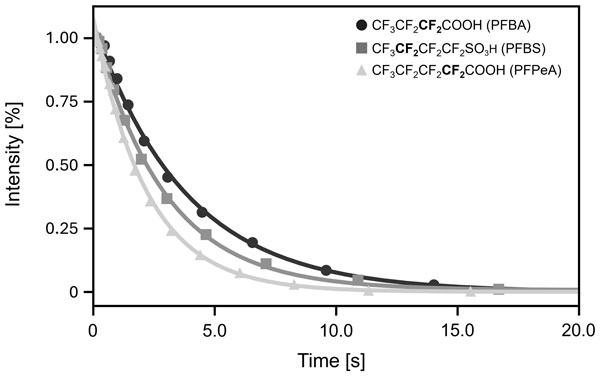
In achiral polyfluoroalkyl substances with two to three CF₂ groups, long-lived ¹⁹F spin states (TLLS) were measured and found to last about three times longer than T₁ in a static 11.6 T field. These lifetimes are sensitive to macromolecular binding, making them useful for screening fluorinated drugs.
Sebastiaan Van Dyck, Coline Wiame, Kirill F. Sheberstov, and Geoffrey Bodenhausen
Magn. Reson., 7, 81–88, https://doi.org/10.5194/mr-7-81-2026, https://doi.org/10.5194/mr-7-81-2026, 2026
Short summary
Short summary
It is shown that proton long-lived states can be observed on benchtop nuclear magnetic resonance spectrometers in molecules containing short aliphatic chains. The effects of strong coupling between methylene groups can be mitigated by optimizing the amplitude and duration of the excitation pulse.
Coline Wiame, Sebastiaan Van Dyck, Kirill Sheberstov, Aiky Razanahoera, and Geoffrey Bodenhausen
Magn. Reson., 6, 273–279, https://doi.org/10.5194/mr-6-273-2025, https://doi.org/10.5194/mr-6-273-2025, 2025
Short summary
Short summary
In achiral polyfluoroalkyl substances with two to three CF₂ groups, long-lived ¹⁹F spin states (TLLS) were measured and found to last about three times longer than T₁ in a static 11.6 T field. These lifetimes are sensitive to macromolecular binding, making them useful for screening fluorinated drugs.
Quentin Stern and Kirill Sheberstov
Magn. Reson., 4, 87–109, https://doi.org/10.5194/mr-4-87-2023, https://doi.org/10.5194/mr-4-87-2023, 2023
Short summary
Short summary
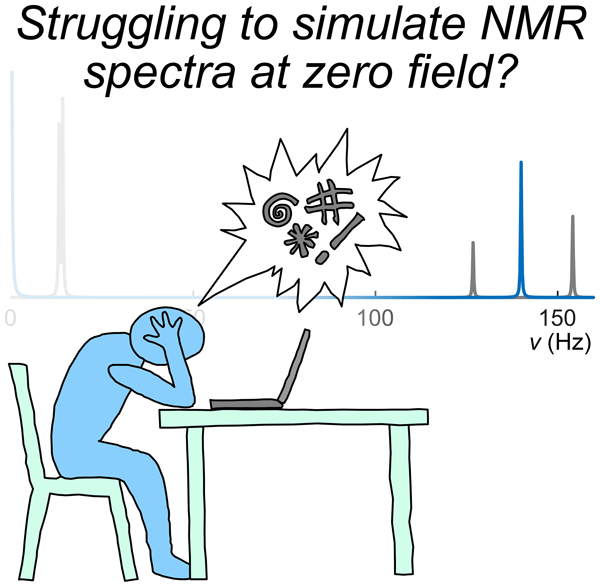
This tutorial paper shows how to simulate NMR spectra at zero to ultralow fields. The process is presented in detail, including the tricks that are usually omitted from research papers and assuming as little prior knowledge from the reader as possible. In this attempt to make NMR simulation approachable, the authors wish to pay tribute to the late Prof. Konstantin L’vovich Ivanov.
Aiky Razanahoera, Anna Sonnefeld, Geoffrey Bodenhausen, and Kirill Sheberstov
Magn. Reson., 4, 47–56, https://doi.org/10.5194/mr-4-47-2023, https://doi.org/10.5194/mr-4-47-2023, 2023
Short summary
Short summary
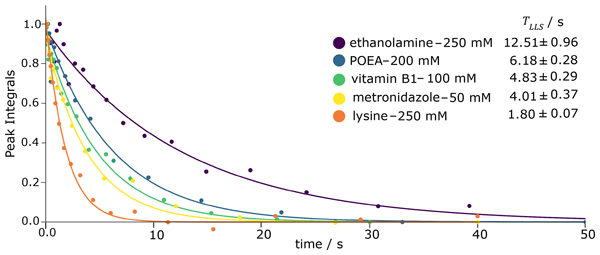
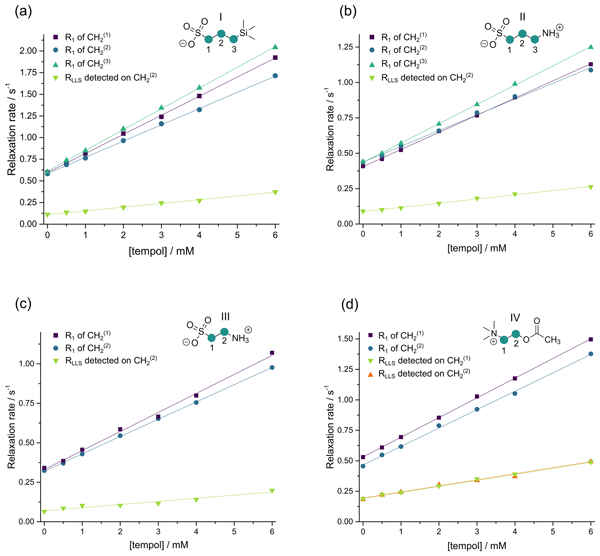
In this work, we study the relaxivity of long-lived states (LLSs) excited across two to three CH2 groups in four different compounds and find that a commonly used polarising agent in dissolution dynamic nuclear polarization (d-DNP) does not enhance relaxation significantly. This result is important for the future implementation of d-DNP hyperpolarization of LLS.
Cited articles
Aguilar, J. A., Faulkner, S., Nilsson, M., and Morris, G. A.: Pure Shift 1H NMR: A Resolution of the Resolution Problem?, Angew. Chem. Int. Ed., 49, 3901–3903, https://doi.org/10.1002/anie.201001107, 2010.
Bocan, J., Pileio, G., and Levitt, M. H.: Sensitivity enhancement and low-field spin relaxation in singlet NMR, Phys. Chem. Chem. Phys., 14, 16032–16040, https://doi.org/10.1039/C2CP42553J, 2012.
Bodenhausen, G., Freeman, R., and Morris, G. A.: A simple pulse sequence for selective excitation in Fourier transform NMR, J. Magn. Reson., 23, 171–175, https://doi.org/10.1016/0022-2364(76)90150-5, 1976.
Bloch, F. and Siegert, A.: Magnetic resonance for nonrotating fields, Phys. Rev., 57, 522–527, https://doi.org/10.1103/PhysRev.57.522, 1940.
Caravatti, P., Bodenhausen, G., and Ernst, R. R.: Selective Pulse Experiments in High-Resolution Solid-State NMR, J. Magn. Reson., 55, 88–103, https://doi.org/10.1016/0022-2364(83)90279-2, 1983.
Carnevale, D., Segawa, T. F., and Bodenhausen, G.: Polychromatic Decoupling of a Manifold of Homonuclear Scalar Interactions in Solution-State NMR, Chem. Eur. J. 18, 11573–11576, https://doi.org/10.1002/chem.201200481, 2012.
Castañar, L. and Parella, T.: Broadband 1H Homodecoupled NMR Experiments: Recent Developments, Methods and Applications, Magn. Reson. Chem. 53, 399–426, https://doi.org/10.1002/mrc.4238, 2015.
Cavanagh, J., Fairbrother, W. J., Palmer III, A. G., Rance, M. and Skelton, N. J.: Protein NMR Spectroscopy: Principles and Practice, 2nd Edn., Academic Press, https://doi.org/10.1016/B978-0-12-164491-8.X5000-3, 2007.
Chávez, M., Wiegand, T., Malär, A. A., Meier, B. H., and Ernst, M.: Residual dipolar line width in magic-angle spinning proton solid-state NMR, Magn. Reson., 2, 499–509, https://doi.org/10.5194/mr-2-499-2021, 2021.
Chung, Y. J., Hoare, Z., Baark, F., Yu, C. S., Guo, J., Fuller, W., Southworth, R., Katschinski, D. M., Murphy, M. P., Eykyn, T. R., and Shattock, M. J.: Elevated Na is a dynamic and reversible modulator of mitochondrial metabolism in the heart, Nat. Commun., 15, 4277, https://doi.org/10.1038/s41467-024-48474-z, 2024.
Davy, M., Dickson, C. L., Wei, R., Uhrín, D., and Butts, C. P.: Monitoring off-resonance signals with SHARPER NMR – the MR-SHARPER experiment, Analyst, 147, 1702–1708, https://doi.org/10.1039/D2AN00134A, 2022.
Dickson, C. L., Peat, G., Rossetto, M., Halse, M. E., and Uhrín, D.: SHARPER-enhanced benchtop NMR: improving SNR by removing couplings and approaching natural linewidths, Chem. Commun., 58, 5534–5537, https://doi.org/10.1039/D2CC01325H, 2022.
Jenne, A., Bermel, W., Michal, C. A., Gruschke, O., Soong, R., Ghosh Biswas, R., Bastawrous, M., and Simpson, A. J.: DREAMTIME NMR spectroscopy: targeted multi-compound selection with improved detection limits, Angew. Chem. Int. Ed., 61, e202110044, https://doi.org/10.1002/anie.202110044, 2022.
Jones, A. B., Lloyd-Jones, G. C., and Uhrín, D.: SHARPER reaction monitoring: generation of a narrow linewidth NMR singlet, without X-pulses, in an inhomogeneous magnetic field, Anal. Chem., 89, 10013–10021, https://doi.org/10.1021/acs.analchem.7b02437, 2017.
Morris, G. A. and Freeman, R.: Selective excitation in Fourier transform nuclear magnetic resonance, J. Magn. Reson., 29, 433–462, https://doi.org/10.1016/0022-2364(78)90003-3, 1978.
Mosher, T. J. and Smith, M. B.: A DANTE tagging sequence for the evaluation of translational sample motion, Magn. Reson. Med., 15, 334–339, https://doi.org/10.1002/mrm.1910150215, 1990.
Redfield, A. G.: Nuclear magnetic resonance saturation and rotary saturation in solids, Phys. Rev., 98, 1787–1809, https://doi.org/10.1103/PhysRev.98.1787, 1955.
Segawa, T. F., Carnevale, D., and Bodenhausen, G.: How to tickle spins with a Fourier transform NMR spectrometer, ChemPhysChem, 14, 369–373, https://doi.org/10.1002/cphc.201200858, 2013.
Sonnefeld, A., Bodenhausen, G., and Sheberstov, K.: Polychromatic excitation of delocalized long-lived proton spin states in aliphatic chains, Phys. Rev. Lett., 129, 183203, https://doi.org/10.1103/PhysRevLett.129.183203, 2022a.
Sonnefeld, A., Razanahoera, A., Pelupessy, P., Bodenhausen, G., and Sheberstov, K.: Long-lived states of methylene protons in achiral molecules, Sci. Adv., 8, eade2113, https://doi.org/10.1126/sciadv.ade2113, 2022b.
Tošner, Z., Brandl, M. J., Blahut, J., Glaser, S. J., and Reif, B.: Maximizing efficiency of dipolar recoupling in solid-state NMR using optimal control sequences, Sci. Adv., 7, eabj5913, https://doi.org/10.1126/sciadv.abj5913, 2021.
Van Dyck, S., Wiame, C., Loutfi, H., Sonnefeld, A., Pelupessy, P., Sheberstov, K., Wadhwa, S., Kampmann, R., and Bodenhausen, G.: Probe with four independent samples for parallel detection in high-resolution solution-state NMR, Rev. Sci. Instrum., in press, 2026.
Wiame, C., Van Dyck, S., Sheberstov, K., Razanahoera, A., and Bodenhausen, G.: Long-lived states involving a manifold of fluorine-19 spins in fluorinated aliphatic chains, Magn. Reson., 6, 273–279, https://doi.org/10.5194/mr-6-273-2025, 2025.
Wiame, C., Loutfi, H., Sheberstov, K., and Bodenhausen, G.: TopSpin pulse sequences for selective spin locking (SSL) and spectra data for the article “Line-narrowing by polychromatic selective spin-locking in NMR”, Zenodo [data set and code], https://doi.org/10.5281/zenodo.22305292, 2026.
Short summary
Selective Spin-Locking (SSL) of the magnetization vectors of selected singlets or multiplets in high-resolution Nuclear Magnetic Resonance (NMR) spectra by mono- or polychromatic selective radio-frequency (RF) irradiation can reduce the linewidths to the limit given by homogeneous T1ρ relaxation in the rotating frame.
Selective Spin-Locking (SSL) of the magnetization vectors of selected singlets or multiplets in...