
Articles | Volume 7, issue 1
https://doi.org/10.5194/mr-7-89-2026
© Author(s) 2026. This work is distributed under
the Creative Commons Attribution 4.0 License.
the Creative Commons Attribution 4.0 License.
https://doi.org/10.5194/mr-7-89-2026
© Author(s) 2026. This work is distributed under
the Creative Commons Attribution 4.0 License.
the Creative Commons Attribution 4.0 License.
Research article
| 
24 Jun 2026
Research article |
| 24 Jun 2026
| 24 Jun 2026
Dual bilinear rotations
Yannik T. Woordes
Institute of Organic Chemistry and Institute for Biological Interfaces 4 – Magnetic Resonance, Karlsruhe Institute of Technology (KIT), Hermann-von-Helmholtz-Platz 1, 76344 Eggenstein-Leopoldshafen, Germany
Institute of Organic Chemistry and Institute for Biological Interfaces 4 – Magnetic Resonance, Karlsruhe Institute of Technology (KIT), Hermann-von-Helmholtz-Platz 1, 76344 Eggenstein-Leopoldshafen, Germany
Related authors
Yannik T. Woordes and Burkhard Luy
Magn. Reson., 7, 1–14, https://doi.org/10.5194/mr-7-1-2026, https://doi.org/10.5194/mr-7-1-2026, 2026
Short summary
Short summary
Bilinear rotations like BIRD, TANGO, BANGO, and BIG-BIRD are essential building blocks in modern nuclear magnetic resonance (NMR) spectroscopy that allow the rotation of an isolated spin without couplings (i.e., bilinear interactions) in one way, while rotating spins with a matched coupling in another way. Two ways for constructing particularly robust bilinear rotations (compensated for couplings, offsets, and B1 inhomogeneities, or COB/COB3) are provided and demonstrated in both theory and experiment.
Yannik T. Woordes and Burkhard Luy
Magn. Reson., 7, 1–14, https://doi.org/10.5194/mr-7-1-2026, https://doi.org/10.5194/mr-7-1-2026, 2026
Short summary
Short summary
Bilinear rotations like BIRD, TANGO, BANGO, and BIG-BIRD are essential building blocks in modern nuclear magnetic resonance (NMR) spectroscopy that allow the rotation of an isolated spin without couplings (i.e., bilinear interactions) in one way, while rotating spins with a matched coupling in another way. Two ways for constructing particularly robust bilinear rotations (compensated for couplings, offsets, and B1 inhomogeneities, or COB/COB3) are provided and demonstrated in both theory and experiment.
Mengjia He, Neil MacKinnon, Dominique Buyens, Burkhard Luy, and Jan G. Korvink
Magn. Reson., 6, 173–181, https://doi.org/10.5194/mr-6-173-2025, https://doi.org/10.5194/mr-6-173-2025, 2025
Short summary
Short summary
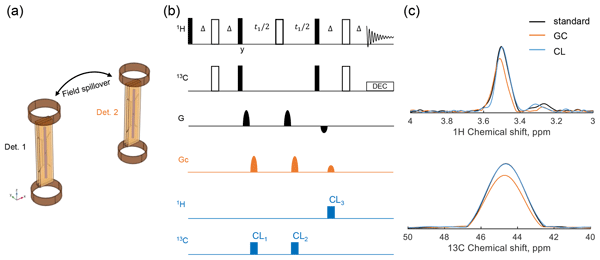
Parallel NMR (nuclear magnetic resonance) detection enhances measurement throughput for high-throughput screening. However, local gradients in parallel detectors cause field spillover in adjacent channels, leading to spin dephasing and signal loss. This study introduces a compensation scheme using optimized pulses to mitigate gradient-induced field inhomogeneity through coherence locking. The proposed approach offers an effective solution for NMR probes with parallel, independently switchable gradient coils.

Jens D. Haller, David L. Goodwin, and Burkhard Luy
Magn. Reson., 3, 53–63, https://doi.org/10.5194/mr-3-53-2022, https://doi.org/10.5194/mr-3-53-2022, 2022
Short summary
Short summary
In contrast to adiabatic excitation, recently introduced SORDOR-90 pulses provide effective transverse 90° rotations throughout their bandwidth, with a quadratic offset dependence of the phase in the x,y plane. Together with phase-matched SORDOR-180 pulses, this enables a direct implementation of the Böhlen–Bodenhausen approach for frequency-swept pulses for a type of 90°/180° pulse–delay sequence. Example pulse shapes are characterised, and an application is given with a 19F-PROJECT experiment.
Neil MacKinnon, Mehrdad Alinaghian, Pedro Silva, Thomas Gloge, Burkhard Luy, Mazin Jouda, and Jan G. Korvink
Magn. Reson., 2, 835–842, https://doi.org/10.5194/mr-2-835-2021, https://doi.org/10.5194/mr-2-835-2021, 2021
Short summary
Short summary
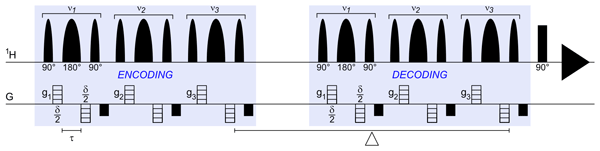
To increase experimental efficiency, information can be encoded in parallel by taking advantage of highly resolved NMR spectra. Here we demonstrate parallel encoding of optimal diffusion parameters by selectively using a resonance for each molecule in the sample. This yields a factor of n decrease in experimental time since n experiments can be encoded into a single measurement. This principle can be extended to additional experimental parameters as a means to further improve measurement time.

Cyril Charlier, Neil Cox, Sophie Martine Prud'homme, Alain Geffard, Jean-Marc Nuzillard, Burkhard Luy, and Guy Lippens
Magn. Reson., 2, 619–627, https://doi.org/10.5194/mr-2-619-2021, https://doi.org/10.5194/mr-2-619-2021, 2021
Short summary
Short summary
The HSQC experiment developed by Bodenhausen and Ruben is a cornerstone for modern NMR. When used in the field of metabolomics, the common practice of decoupling in the proton dimension limits the acquisition time and hence the resolution. Here, we present a virtual decoupling method to maintain both spectral simplicity and resolution, and demonstrate how it increases information content with the zebra mussel metabolome as an example.
Cited articles
Aguilar, J. A., Nilsson, M., and Morris, G. A.: Simple Proton Spectra from Complex Spin Systems: Pure Shift NMR Spectroscopy Using BIRD, Angew. Chem. Int. Edit., 50, 9716–9717, https://doi.org/10.1002/anie.201103789, 2011. a
Bauer, C., Freeman, R., and Wimperis, S.: Long-Range Carbon-Proton Coupling Constants, J. Magn. Reson., 58, 526–532, https://doi.org/10.1016/0022-2364(84)90161-6, 1984. a
Bax, A.: Broadband Homonuclear Decoupling in Heteronuclear Shift Correlation NMR Spectroscopy, J. Magn. Reson., 53, 517–520, https://doi.org/10.1016/0022-2364(83)90225-1, 1983. a
Berger, S.: Selective Inverse Correlation of 13C and 1H NMR Signals, an Alternative to 2D NMR, J. Magn. Reson., 81, 561–564, https://doi.org/10.1016/0022-2364(89)90093-0, 1989. a
Bigler, P., Gjuroski, I., Chakif, D., and Furrer, J.: A Versatile Broadband Attached Proton Test Experiment for Routine 13C Nuclear Magnetic Resonance Spectroscopy, Molecules, 29, 809, https://doi.org/10.3390/molecules29040809, 2024. a, b
Bodor, A., Haller, J. D., Bouguechtouli, C., Theillet, F.-X., Nyitray, L., and Luy, B.: Power of Pure Shift Hα,Cα Correlations: A Way to Characterize Biomolecules under Physiological Conditions, Anal. Chem., 92, 12423–12428, https://doi.org/10.1021/acs.analchem.0c02182, 2020. a, b
Briand, J. and Sørensen, O. W.: A Novel Pulse Sequence Element for Biselective and Independent Rotations with Arbitrary Flip Angles and Phases for I and I{S} Spin Systems, J. Magn. Reson., 125, 202–206, https://doi.org/10.1006/jmre.1996.1095, 1997. a
Brown, D. W., Nakashima, T. T., and Rabenstein, D. L.: Simplification and Assignment of Carbon-13 NMR Spectra with Spin-Echo Fourier Transform Techniques, J. Magn. Reson., 45, 302–314, https://doi.org/10.1016/0022-2364(81)90127-X, 1981. a, b
Castañar, L. and Parella, T.: Broadband 1H Homodecoupled NMR Experiments: Recent Developments, Methods and Applications, Magn. Reson. Chem., 53, 399–426, https://doi.org/10.1002/mrc.4238, 2015. a
Davis, D. G.: Improved Multiplet Editing of Proton-Detected, Heteronuclear Shift-Correlation Spectra, J. Magn. Reson., 91, 665–672, https://doi.org/10.1016/0022-2364(91)90398-D, 1991. a
Donovan, K. J. and Frydman, L.: HyperBIRD: A Sensitivity-Enhanced Approach to Collecting Homonuclear-Decoupled Proton NMR Spectra, Angew. Chem. Int. Edit., 54, 594–598, https://doi.org/10.1002/anie.201407869, 2015. a
Ehni, S. and Luy, B.: BEBEtr and BUBI: J-compensated Concurrent Shaped Pulses for 1H–13C Experiments, J. Magn. Reson., 232, 7–17, https://doi.org/10.1016/j.jmr.2013.04.007, 2013. a
Ehni, S., Koos, M. R., Reinsperger, T., Haller, J. D., Goodwin, D. L., and Luy, B.: Concurrent J-evolving Refocusing Pulses, J. Magn. Reson., 336, 107 152, https://doi.org/10.1016/j.jmr.2022.107152, 2022. a
Fehér, K., Berger, S., and Kövér, K. E.: Accurate Determination of Small One-Bond Heteronuclear Residual Dipolar Couplings by F1 Coupled HSQC Modified with a G-BIRDr Module, J. Magn. Reson., 163, 340–346, https://doi.org/10.1016/S1090-7807(03)00113-7, 2003. a, b
Furrer, J., John, M., Kessler, H., and Luy, B.: J-Spectroscopy in the Presence of Residual Dipolar Couplings: Determination of One-Bond Coupling Constants and Scalable Resolution, J. Biomol. NMR, 37, 231–243, https://doi.org/10.1007/s10858-006-9130-x, 2007. a
Garbow, J. R., Weitekamp, D. P., and Pines, A.: Bilinear Rotation Decoupling of Homonuclear Scalar Interactions, Chem. Phys. Lett., 93, 504–509, https://doi.org/10.1016/0009-2614(82)83229-6, 1982. a, b
Gyöngyösi, T., Timári, I., Sinnaeve, D., Luy, B., and Kövér, K. E.: Expedited Nuclear Magnetic Resonance Assignment of Small- to Medium-Sized Molecules with Improved HSQC-CLIP-COSY Experiments, Anal. Chem., 93, 3096–3102, https://doi.org/10.1021/acs.analchem.0c04124, 2021. a
Haller, J. D., Bodor, A., and Luy, B.: Real-Time Pure Shift Measurements for Uniformly Isotope-Labeled Molecules Using X-selective BIRD Homonuclear Decoupling, J. Magn. Reson., 302, 64–71, https://doi.org/10.1016/j.jmr.2019.03.011, 2019. a, b
Haller, J. D., Bodor, A., and Luy, B.: Pure Shift Amide Detection in Conventional and TROSY-type Experiments of 13C,15N-labeled Proteins, J. Biomol. NMR, 76, 213–221, https://doi.org/10.1007/s10858-022-00406-z, 2022. a
Kaltschnee, L., Kolmer, A., Timári, I., Schmidts, V., W. Adams, R., Nilsson, M., E. Kövér, K., A. Morris, G., and M. Thiele, C.: “Perfecting” Pure Shift HSQC: Full Homodecoupling for Accurate and Precise Determination of Heteronuclear Couplings, Chem. Commun., 50, 15702–15705, https://doi.org/10.1039/C4CC04217D, 2014. a
Kay, L. E. and Bax, A.: Separation of NH and NH2 Resonances in 1H-detected Heteronuclear Multiple-Quantum Correlation Spectra, J. Magn. Reson., 84, 598–603, https://doi.org/10.1016/0022-2364(89)90125-X, 1989. a
Kiraly, P., Adams, R. W., Paudel, L., Foroozandeh, M., Aguilar, J. A., Timári, I., Cliff, M. J., Nilsson, M., Sándor, P., Batta, G., Waltho, J. P., Kövér, K. E., and Morris, G. A.: Real-Time Pure Shift 15N HSQC of Proteins: A Real Improvement in Resolution and Sensitivity, J. Biomol. NMR, 62, 43–52, https://doi.org/10.1007/s10858-015-9913-z, 2015. a
Koos, M. R. M. and Luy, B.: Polarization Recovery during ASAP and SOFAST/ALSOFAST-type Experiments, J. Magn. Reson., 300, 61–75, https://doi.org/10.1016/j.jmr.2018.12.014, 2019. a, b
Koskela, H., Kilpeläinen, I., and Heikkinen, S.: CAGEBIRD: Improving the GBIRD Filter with a CPMG Sequence, J. Magn. Reson., 170, 121–126, https://doi.org/10.1016/j.jmr.2004.06.007, 2004. a
Kurz, M., Schmieder, P., and Kessler, H.: HETLOC, an Efficient Method for Determining Heteronuclear Long-Range Couplings with Heteronuclei in Natural Abundance, Angew. Chem. Int. Edit., 30, 1329–1331, https://doi.org/10.1002/anie.199113291, 1991. a
Lupulescu, A., Olsen, G. L., and Frydman, L.: Toward Single-Shot Pure-Shift Solution 1H NMR by Trains of BIRD-based Homonuclear Decoupling, J. Magn. Reson., 218, 141–146, https://doi.org/10.1016/j.jmr.2012.02.018, 2012. a, b
Nagy, T. M., Kövér, K. E., and Sørensen, O. W.: NORD: NO Relaxation Delay NMR Spectroscopy, Angew. Chem. Int. Edit., 60, 13 587–13 590, https://doi.org/10.1002/anie.202102487, 2021. a, b, c
Patt, S. L. and Shoolery, J. N.: Attached Proton Test for Carbon-13 NMR, J. Magn. Reson., 46, 535–539, https://doi.org/10.1016/0022-2364(82)90105-6, 1982. a
Poppe, L., York, W. S., and van Halbeek, H.: Measurement of Inter-Glycosidic 13C-1H Coupling Constants in a Cyclic β(1→2)-Glucan by 13C-filtered 2D {1H,1H}ROESY, J. Biomol. NMR, 3, 81–89, https://doi.org/10.1007/BF00242477, 1993. a
Rance, M., Wright, P. E., Messerle, B. A., and Field, L. D.: Site-Selective Observation of Nuclear Overhauser Effects in Proteins via Isotopic Labeling, J. Am. Chem. Soc., 109, 1591–1593, https://doi.org/10.1021/ja00239a062, 1987. a
Reinsperger, T. and Luy, B.: Homonuclear BIRD-decoupled Spectra for Measuring One-Bond Couplings with Highest Resolution: CLIP/CLAP-RESET and Constant-Time-CLIP/CLAP-RESET, J. Magn. Reson., 239, 110–120, https://doi.org/10.1016/j.jmr.2013.11.015, 2014. a
Reynolds, W. F., McLean, S., Perpick-Dumont, M., and Enríquez, R. G.: Improved 13C-1H Shift Correlation Spectra for Indirectly Bonded Carbons and Hydrogens: The FLOCK Sequence, Magn. Reson. Chem., 27, 162–169, https://doi.org/10.1002/mrc.1260270214, 1989. a
Rutar, V.: Separate Measurements of Heteronuclear J Coupling Constants by Manipulated Polarization Transfer in Two-Dimensional NMR, J. Am. Chem. Soc., 105, 4095–4096, https://doi.org/10.1021/ja00350a060, 1983. a
Sakhaii, P., Haase, B., and Bermel, W.: Experimental Access to HSQC Spectra Decoupled in All Frequency Dimensions, J. Magn. Reson., 199, 192–198, https://doi.org/10.1016/j.jmr.2009.04.016, 2009. a
Saurí, J., Bermel, W., Buevich, A. V., Sherer, E. C., Joyce, L. A., Sharaf, M. H. M., Schiff Jr., P. L., Parella, T., Williamson, R. T., and Martin, G. E.: Homodecoupled 1,1- and 1,n-ADEQUATE: Pivotal NMR Experiments for the Structure Revision of Cryptospirolepine, Angew. Chem., 127, 10 298–10 302, https://doi.org/10.1002/ange.201502540, 2015. a
Saurí, J., Parella, T., Williamson, R. T., and Martin, G. E.: Improving the Performance of J-modulated ADEQUATE Experiments through Homonuclear Decoupling and Non-Uniform Sampling, Magn. Reson. Chem., 55, 191–197, https://doi.org/10.1002/mrc.4322, 2017. a
Schmieder, P., Domket, T., Norris, D. G., Kurz, M., Kessler, H., and Leibfritz, D.: Editing of Multiplicity in Two- and Three-Dimensional Heteronuclear NMR Spectroscopy by Fourier Transformation of the Pulse-Angle Dependency, J. Magn. Reson., 93, 430–435, https://doi.org/10.1016/0022-2364(91)90021-K, 1991a. a
Schmieder, P., Kurz, M., and Kessler, H.: Determination of Heteronuclear Long-Range Couplings to Heteronuclei in Natural Abundance by Two- and Three-Dimensional NMR Spectroscopy, J. Biomol. NMR, 1, 403–420, https://doi.org/10.1007/BF02192863, 1991b. a
Schulze-Sünninghausen, D., Becker, J., Koos, M. R. M., and Luy, B.: Improvements, Extensions, and Practical Aspects of Rapid ASAP-HSQC and ALSOFAST-HSQC Pulse Sequences for Studying Small Molecules at Natural Abundance, J. Magn. Reson., 281, 151–161, https://doi.org/10.1016/j.jmr.2017.05.012, 2017. a, b
Schulze-Sünninghausen, D., Becker, J., Koos, M. R. M., and Luy, B.: LowCOST-HSQC Variants for Fast Pulsing High ω1-Resolved 2D-experiments, Magn. Reson. Chem., 64, 655–665, https://doi.org/10.1002/mrc.70102, 2026. a
Sebák, F., Ecsédi, P., Bermel, W., Luy, B., Nyitray, L., and Bodor, A.: Selective 1Hα NMR Methods Reveal Functionally Relevant Proline Cis/Trans Isomers in Intrinsically Disordered Proteins: Characterization of Minor Forms, Effects of Phosphorylation, and Occurrence in Proteome, Angew. Chem. Int. Edit., 61, e202108361, https://doi.org/10.1002/anie.202108361, 2022. a
Sørensen, O. W.: Selective Rotations Using Non-Selective Pulses and Heteronuclear Couplings, Bull. Magn. Reson., 16, 49–53, 1994. a
Sørensen, O. W.: The Generalized Ernst Angle, J. Magn. Reson. Open, 19, 100148, https://doi.org/10.1016/j.jmro.2024.100148, 2024. a, b
Timári, I., Kaltschnee, L., Kolmer, A., Adams, R. W., Nilsson, M., Thiele, C. M., Morris, G. A., and Kövér, K. E.: Accurate Determination of One-Bond Heteronuclear Coupling Constants with “Pure Shift” Broadband Proton-Decoupled CLIP/CLAP-HSQC Experiments, J. Magn. Reson., 239, 130–138, https://doi.org/10.1016/j.jmr.2013.10.023, 2014. a
Timári, I., Kaltschnee, L., H. Raics, M., Roth, F., A. Bell, N. G., W. Adams, R., Nilsson, M., Uhrín, D., A. Morris, G., M. Thiele, C., and E. Kövér, K.: Real-Time Broadband Proton-Homodecoupled CLIP/CLAP-HSQC for Automated Measurement of Heteronuclear One-Bond Coupling Constants, RSC Adv., 6, 87848–87855, https://doi.org/10.1039/C6RA14329F, 2016. a
Torres, A. M., McClung, R. E. D., and Nakashima, T. T.: Compensated APT Pulse Sequences, J. Magn. Reson., 87, 189–193, https://doi.org/10.1016/0022-2364(90)90099-U, 1990. a
Torres, A. M., Nakashima, T. T., and Mcclung, R. E. D.: Improved J-Compensated Apt Experiments, J. Magn. Reson. A, 101, 285–294, https://doi.org/10.1006/jmra.1993.1044, 1993. a
Uhrín, D., Liptaj, T., and Kövér, K. E.: Modified BIRD Pulses and Design of Heteronuclear Pulse Sequences, J. Magn. Reson. A, 101, 41–46, https://doi.org/10.1006/jmra.1993.1005, 1993. a
Willker, W., Leibfritz, D., Kerssebaum, R., and Bermel, W.: Gradient Selection in Inverse Heteronuclear Correlation Spectroscopy, Magn. Reson. Chem., 31, 287–292, https://doi.org/10.1002/mrc.1260310315, 1993. a
Wimperis, S. and Freeman, R.: An Excitation Sequence Which Discriminates between Direct and Long-Range CH Coupling, J. Magn. Reson., 58, 348–353, https://doi.org/10.1016/0022-2364(84)90227-0, 1984. a
Woordes, Y. T. and Luy, B.: Dual Bilinear Rotations – Data, Karlsruhe Institute of Technology [data set], https://doi.org/10.35097/6d6mmwg567q7hku7, 2026. a
Zhang, X. and Wang, C.: 1H-Detected Editable Heteronuclear Multiple-Quantum Correlation Experiment at Natural Abundance, J. Magn. Reson., 91, 618–623, https://doi.org/10.1016/0022-2364(91)90390-F, 1991. a
Short summary
Dual bilinear rotations are introduced, which lead to well-defined rotations for both heteronuclear spins I and S that depend on the presence or absence of a (large) coupling between them. These are therefore an extension of conventional bilinear rotations, which cause such a spin-system-dependent rotation only for the spin I. A general derivation of the approach is given, and a quadruple-J-resolved type experiment is introduced for demonstration.
Dual bilinear rotations are introduced, which lead to well-defined rotations for both...


