Articles | Volume 4, issue 1
https://doi.org/10.5194/mr-4-87-2023
© Author(s) 2023. This work is distributed under
the Creative Commons Attribution 4.0 License.
https://doi.org/10.5194/mr-4-87-2023
© Author(s) 2023. This work is distributed under
the Creative Commons Attribution 4.0 License.
Simulation of NMR spectra at zero and ultralow fields from A to Z – a tribute to Prof. Konstantin L'vovich Ivanov
Quentin Stern
CORRESPONDING AUTHOR
Univ Lyon, ENS Lyon, UCBL, CNRS, CRMN UMR 5082, 69100, VILLEURBANNE, France
Kirill Sheberstov
Laboratoire des biomolécules (LBM), Département de chimie,
École normale supérieure, PSL University, Sorbonne Université,
CNRS, 75005 Paris, France
Related authors
Arnab Dey, Benoît Charrier, Karine Lemaitre, Victor Ribay, Dmitry Eshchenko, Marc Schnell, Roberto Melzi, Quentin Stern, Samuel F. Cousin, James G. Kempf, Sami Jannin, Jean-Nicolas Dumez, and Patrick Giraudeau
Magn. Reson., 3, 183–202, https://doi.org/10.5194/mr-3-183-2022, https://doi.org/10.5194/mr-3-183-2022, 2022
Short summary
Short summary
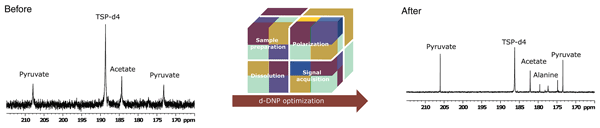
Nuclear magnetic resonance (NMR) is a great tool for analytical chemistry, but it is not the most sensitive one. This work aims to develop a sensitive and repeatable workflow for the analysis of complex samples by hyperpolarized 13C NMR. Through systematic and careful optimization of experimental parameters, we were able to achieve unprecedented sensitivity for the analysis of naturally abundant metabolite mixtures while maintaining the precision required for metabolomic studies.
Sebastiaan Van Dyck, Coline Wiame, Kirill F. Sheberstov, and Geoffrey Bodenhausen
Magn. Reson. Discuss., https://doi.org/10.5194/mr-2026-5, https://doi.org/10.5194/mr-2026-5, 2026
Preprint under review for MR
Short summary
Short summary
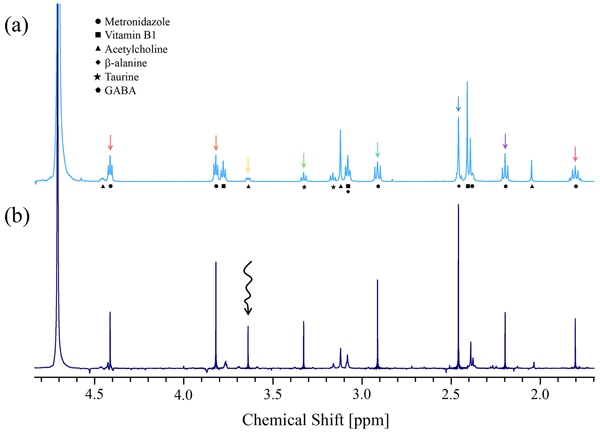
It is shown that proton long-lived states can be observed on benchtop NMR spectrometers in molecules containing short aliphatic chains. The effects of strong coupling between methylene groups can be mitigated by optimizing the amplitude and duration of the excitation pulse.
Coline Wiame, Sebastiaan Van Dyck, Kirill Sheberstov, Aiky Razanahoera, and Geoffrey Bodenhausen
Magn. Reson., 6, 273–279, https://doi.org/10.5194/mr-6-273-2025, https://doi.org/10.5194/mr-6-273-2025, 2025
Short summary
Short summary
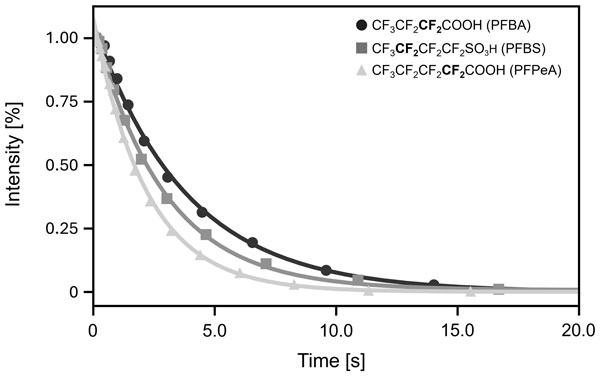
In achiral polyfluoroalkyl substances with two to three CF₂ groups, long-lived ¹⁹F spin states (TLLS) were measured and found to last about three times longer than T₁ in a static 11.6 T field. These lifetimes are sensitive to macromolecular binding, making them useful for screening fluorinated drugs.
Aiky Razanahoera, Anna Sonnefeld, Geoffrey Bodenhausen, and Kirill Sheberstov
Magn. Reson., 4, 47–56, https://doi.org/10.5194/mr-4-47-2023, https://doi.org/10.5194/mr-4-47-2023, 2023
Short summary
Short summary
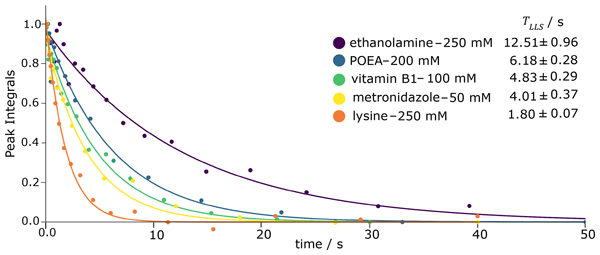
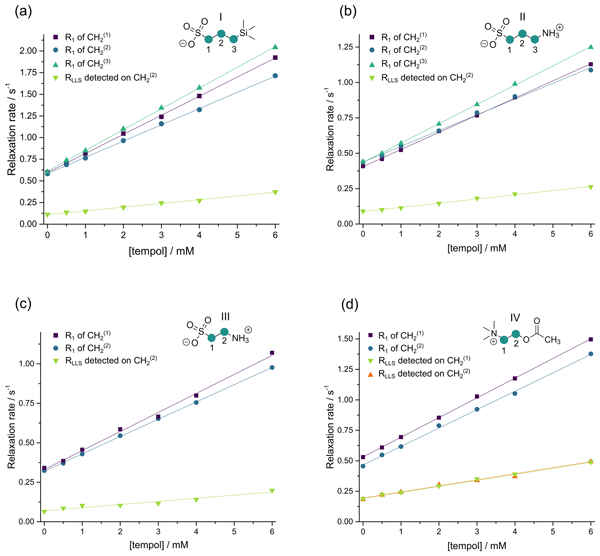
In this work, we study the relaxivity of long-lived states (LLSs) excited across two to three CH2 groups in four different compounds and find that a commonly used polarising agent in dissolution dynamic nuclear polarization (d-DNP) does not enhance relaxation significantly. This result is important for the future implementation of d-DNP hyperpolarization of LLS.
Arnab Dey, Benoît Charrier, Karine Lemaitre, Victor Ribay, Dmitry Eshchenko, Marc Schnell, Roberto Melzi, Quentin Stern, Samuel F. Cousin, James G. Kempf, Sami Jannin, Jean-Nicolas Dumez, and Patrick Giraudeau
Magn. Reson., 3, 183–202, https://doi.org/10.5194/mr-3-183-2022, https://doi.org/10.5194/mr-3-183-2022, 2022
Short summary
Short summary
Nuclear magnetic resonance (NMR) is a great tool for analytical chemistry, but it is not the most sensitive one. This work aims to develop a sensitive and repeatable workflow for the analysis of complex samples by hyperpolarized 13C NMR. Through systematic and careful optimization of experimental parameters, we were able to achieve unprecedented sensitivity for the analysis of naturally abundant metabolite mixtures while maintaining the precision required for metabolomic studies.
Cited articles
Alcicek, S., Put, P., Barskiy, D., Kontul, V., and Pustelny, S.: Zero-Field
NMR of Urea: Spin-Topology Engineering by Chemical Exchange, J. Phys. Chem.
Lett., 12, 10671–10676, https://doi.org/10.1021/acs.jpclett.1c02768, 2021.
Appelt, S., Kühn, H., Häsing, F. W., and Blümich, B.: Chemical
analysis by ultrahigh-resolution nuclear magnetic resonance in the Earth's
magnetic field, Nat. Phys., 2, 105–109, https://doi.org/10.1038/nphys211,
2006.
Appelt, S., Häsing, F. W., Sieling, U., Gordji-Nejad, A., Glöggler,
S., and Blümich, B.: Paths from weak to strong coupling in NMR, Phys.
Rev. A, 81, 023420, https://doi.org/10.1103/PhysRevA.81.023420, 2010.
Barskiy, D. A., Tayler, M. C. D., Marco-Rius, I., Kurhanewicz, J., Vigneron,
D. B., Cikrikci, S., Aydogdu, A., Reh, M., Pravdivtsev, A. N., Hövener,
J.-B., Blanchard, J. W., Wu, T., Budker, D., and Pines, A.: Zero-field
nuclear magnetic resonance of chemically exchanging systems, Nat. Commun., 10,
3002, https://doi.org/10.1038/s41467-019-10787-9, 2019.
Bengs, C. and Levitt, M. H.: SpinDynamica: Symbolic and numerical magnetic
resonance in a Mathematica environment, Magn. Reson. Chem., 56,
374–414, https://doi.org/10.1002/mrc.4642, 2018.
Blanchard, J. W.: Zero and Ultra-Low-Field Nuclear Magnetic Resonance
Spectroscopy Via Optical Magnetometry, PhD thesis, UC Berkeley, https://escholarship.org/uc/item/2mp738zn (last access: 22 March 2023), 2014.
Blanchard, J. W. and Budker, D.: Zero- to Ultralow-Field NMR, eMagRes,
5, 1395–1410,
https://doi.org/10.1002/9780470034590.emrstm1369, 2016.
Blanchard, J. W., Sjolander, T. F., King, J. P., Ledbetter, M. P., Levine,
E. H., Bajaj, V. S., Budker, D., and Pines, A.: Measurement of untruncated
nuclear spin interactions via zero- to ultralow-field nuclear magnetic
resonance, Phys. Rev. B, 92, 220202,
https://doi.org/10.1103/PhysRevB.92.220202, 2015.
Blanchard, J. W., Wu, T., Eills, J., Hu, Y., and Budker, D.: Zero- to
ultralow-field nuclear magnetic resonance J-spectroscopy with commercial
atomic magnetometers, J. Magn. Reson., 314, 106723,
https://doi.org/10.1016/j.jmr.2020.106723, 2020.
Blanchard, J. W., Budker, D., and Trabesinger, A.: Lower than low:
Perspectives on zero- to ultralow-field nuclear magnetic resonance, J. Magn. Reson., 323, 106886,
https://doi.org/10.1016/j.jmr.2020.106886, 2021.
Bodenstedt, S., Mitchell, M. W., and Tayler, M. C.: Fast-field-cycling
ultralow-field nuclear magnetic relaxation dispersion, Nat.
Commun., 12, 1–8, 2021.
Bodenstedt, S., Moll, D., Glöggler, S., Mitchell, M. W., and Tayler, M.
C. D.: Decoupling of Spin Decoherence Paths near Zero Magnetic Field, J.
Phys. Chem. Lett., 13, 98–104, https://doi.org/10.1021/acs.jpclett.1c03714,
2022a.
Bodenstedt, S., Mitchell, M. W., and Tayler, M. C. D.: Meridional composite
pulses for low-field magnetic resonance, Phys. Rev. A, 106, 033102,
https://doi.org/10.1103/PhysRevA.106.033102, 2022b.
Butler, M. C., Ledbetter, M. P., Theis, T., Blanchard, J. W., Budker, D.,
and Pines, A.: Multiplets at zero magnetic field: The geometry of zero-field
NMR, J. Chem. Phys., 138, 184202,
https://doi.org/10.1063/1.4803144, 2013a.
Butler, M. C., Kervern, G., Theis, T., Ledbetter, M. P., Ganssle, P. J.,
Blanchard, J. W., Budker, D., and Pines, A.: Parahydrogen-induced
polarization at zero magnetic field, J. Chem. Phys., 138,
234201, https://doi.org/10.1063/1.4805062, 2013b.
Callaghan, P. T. and Le Gros, M.: Nuclear spins in the Earth's magnetic
field, Am. J. Phys., 50, 709–713,
https://doi.org/10.1119/1.12735, 1982.
Emondts, M., Ledbetter, M. P., Pustelny, S., Theis, T., Patton, B.,
Blanchard, J. W., Butler, M. C., Budker, D., and Pines, A.: Long-Lived
Heteronuclear Spin-Singlet States in Liquids at a Zero Magnetic field, Phys.
Rev. Lett., 112, 077601, https://doi.org/10.1103/PhysRevLett.112.077601,
2014.
Hogben, H. J., Krzystyniak, M., Charnock, G. T. P., Hore, P. J., and Kuprov,
I.: Spinach – A software library for simulation of spin dynamics in large
spin systems, J. Magn. Reson., 208, 179–194,
https://doi.org/10.1016/j.jmr.2010.11.008, 2011.
Hore, P. J., Jones, J. A., and Wimperis, S.: NMR: The Toolkit: how Pulse
Sequences Work, 2nd Edn., Vol. 92, Oxford University Press,
ISBN 978-0-19-870342-6, 2015.
Jiang, M., Wu, T., Blanchard, J. W., Feng, G., Peng, X., and Budker, D.:
Experimental benchmarking of quantum control in zero-field nuclear magnetic
resonance, Sci. Adv., 4, eaar6327, https://doi.org/10.1126/sciadv.aar6327,
2018.
Jiang, M., Bian, J., Li, Q., Wu, Z., Su, H., Xu, M., Wang, Y., Wang, X., and
Peng, X.: Zero- to ultralow-field nuclear magnetic resonance and its
applications, Fundamental Research, 1, 68–84,
https://doi.org/10.1016/j.fmre.2020.12.007, 2021.
Keeler, J.: Understanding NMR spectroscopy, John Wiley & Sons, ISBN 978-0-470-74609-7, 2010.
Kiryutin, A. S., Zhukov, I. V., Ferrage, F., Bodenhausen, G., Yurkovskaya,
A. V., and Ivanov, K. L.: Sequential assignment of NMR spectra of peptides
at natural isotopic abundance with zero- and ultra-low-field total
correlation spectroscopy (ZULF-TOCSY), Phys. Chem. Chem. Phys., 23,
9715–9720, https://doi.org/10.1039/D0CP06337A, 2021.
Ledbetter, M. P., Crawford, C. W., Pines, A., Wemmer, D. E., Knappe, S.,
Kitching, J., and Budker, D.: Optical detection of NMR J-spectra at zero
magnetic field, J. Magn. Reson., 199, 25–29,
https://doi.org/10.1016/j.jmr.2009.03.008, 2009.
Ledbetter, M. P., Theis, T., Blanchard, J. W., Ring, H., Ganssle, P.,
Appelt, S., Blümich, B., Pines, A., and Budker, D.: Near-Zero-Field
Nuclear Magnetic Resonance, Phys. Rev. Lett., 107, 107601,
https://doi.org/10.1103/PhysRevLett.107.107601, 2011.
Levitt, M. H.: Spin Dynamics: Basics of Nuclear Magnetic Resonance, John
Wiley & Sons, 885 pp., ISBN 978-0-470-51118-3, 2013.
Otting, G., Widmer, H., Wagner, G., and Wüthrich, K.: Origin of t2 and
t2 ridges in 2D NMR spectra and procedures for suppression, J.
Magn. Reson., 66, 187–193,
https://doi.org/10.1016/0022-2364(86)90122-8, 1986.
Picazo-Frutos, R., Stern, Q., Blanchard, J. W., Cala, O., Ceillier, M.,
Cousin, S. F., Eills, J., Elliott, S. J., Jannin, S., and Budker, D.: Zero-
to Ultralow-Field Nuclear Magnetic Resonance Enhanced with Dissolution
Dynamic Nuclear Polarization, Anal. Chem., 95, 720–729,
https://doi.org/10.1021/acs.analchem.2c02649, 2023.
Put, P., Pustelny, S., Budker, D., Druga, E., Sjolander, T. F., Pines, A.,
and Barskiy, D. A.: Zero- to Ultralow-Field NMR Spectroscopy of Small
Biomolecules, Anal. Chem., 93, 3226–3232,
https://doi.org/10.1021/acs.analchem.0c04738, 2021.
Schwalbe, H.: Editorial: New 1.2 GHz NMR Spectrometers – New Horizons?,
Angew. Chem. Int. Edit., 56, 10252–10253,
https://doi.org/10.1002/anie.201705936, 2017.
Sjolander, T. F.: Advances in Pulsed Zero-Field NMR Spectroscopy, PhD
thesis, UC Berkeley, https://escholarship.org/uc/item/2kj4v04n (last access: 22 March 2023), 2017.
Stern, Q. and Sheberstov, K.: Fourier transform, simulations of spectra, and analytical calculations, Zenodo [code], https://doi.org/10.5281/zenodo.7758782, 2023.
Tayler, M. C. D., Theis, T., Sjolander, T. F., Blanchard, J. W., Kentner,
A., Pustelny, S., Pines, A., and Budker, D.: Invited Review Article:
Instrumentation for nuclear magnetic resonance in zero and ultralow magnetic
field, Rev. Sci. Instrum., 88, 091101,
https://doi.org/10.1063/1.5003347, 2017.
Thayer, A. M. and Pines, A.: Zero-field NMR, Accounts Chem. Res.,
20, 47–53, 1987.
Theis, T.: Advances in Zero-Field Nuclear Magnetic Resonance Spectroscopy,
PhD thesis, UC Berkeley, https://escholarship.org/uc/item/01d528kh (last access: 22 March 2023), 2012.
Theis, T., Ganssle, P., Kervern, G., Knappe, S., Kitching, J., Ledbetter, M. P.,
Budker, D., and Pines, A.: Parahydrogen-enhanced zero-field nuclear magnetic
resonance, Nat. Phys., 7, 571–575, 2011.
Theis, T., Ledbetter, M. P., Kervern, G., Blanchard, J. W., Ganssle, P. J.,
Butler, M. C., Shin, H. D., Budker, D., and Pines, A.: Zero-Field NMR
Enhanced by Parahydrogen in Reversible Exchange, J. Am. Chem. Soc., 134,
3987–3990, https://doi.org/10.1021/ja2112405, 2012.
Theis, T., Blanchard, J. W., Butler, M. C., Ledbetter, M. P., Budker, D.,
and Pines, A.: Chemical analysis using J-coupling multiplets in zero-field
NMR, Chem. Phys. Lett., 580, 160–165,
https://doi.org/10.1016/j.cplett.2013.06.042, 2013.
Weitekamp, D. P., Bielecki, A., Zax, D., Zilm, K., and Pines, A.: Zero-Field
Nuclear Magnetic Resonance, Phys. Rev. Lett., 50, 1807–1810,
https://doi.org/10.1103/PhysRevLett.50.1807, 1983.
Wikus, P., Frantz, W., Kümmerle, R., and Vonlanthen, P.: Commercial
gigahertz-class NMR magnets, Supercond. Sci. Tech., 35, 033001,
https://doi.org/10.1088/1361-6668/ac4951, 2022.
Wilzewski, A., Afach, S., Blanchard, J. W., and Budker, D.: A method for
measurement of spin-spin couplings with sub-mHz precision using zero- to
ultralow-field nuclear magnetic resonance, J. Magn. Reson.,
284, 66–72, https://doi.org/10.1016/j.jmr.2017.08.016, 2017.
Yurkovskaya, A. and Bodenhausen, G.: In memoriam Konstantin L'vovich Ivanov, Magn. Reson., 2, 341–342, https://doi.org/10.5194/mr-2-341-2021, 2021.
Zhu, G., Torchia, D. A., and Bax, A.: Discrete Fourier Transformation of NMR
Signals. The Relationship between Sampling Delay Time and Spectral Baseline,
J. Magn. Reson. Ser. A, 105, 219–222,
https://doi.org/10.1006/jmra.1993.1274, 1993.
Short summary
This tutorial paper shows how to simulate NMR spectra at zero to ultralow fields. The process is presented in detail, including the tricks that are usually omitted from research papers and assuming as little prior knowledge from the reader as possible. In this attempt to make NMR simulation approachable, the authors wish to pay tribute to the late Prof. Konstantin L’vovich Ivanov.
This tutorial paper shows how to simulate NMR spectra at zero to ultralow fields. The process is...