Articles | Volume 5, issue 2
https://doi.org/10.5194/mr-5-167-2024
© Author(s) 2024. This work is distributed under
the Creative Commons Attribution 4.0 License.
https://doi.org/10.5194/mr-5-167-2024
© Author(s) 2024. This work is distributed under
the Creative Commons Attribution 4.0 License.
Workflow for systematic design of electrochemical in operando NMR cells by matching B0 and B1 field simulations with experiments
Institute of Energy Technologies, Fundamental Electrochemistry (IET-1), Forschungszentrum Jülich, Jülich, Germany
Institute of Technical and Macromolecular Chemistry, RWTH Aachen University, Aachen, Germany
Matthias Streun
Central Institute of Engineering and Analytics, Electronic Systems (ZEA-2), Forschungszentrum Jülich, Jülich, Germany
Sven Jovanovic
Institute of Energy Technologies, Fundamental Electrochemistry (IET-1), Forschungszentrum Jülich, Jülich, Germany
Rüdiger-A. Eichel
Institute of Energy Technologies, Fundamental Electrochemistry (IET-1), Forschungszentrum Jülich, Jülich, Germany
Institute of Physical Chemistry, RWTH Aachen University, Aachen, Germany
Josef Granwehr
Institute of Energy Technologies, Fundamental Electrochemistry (IET-1), Forschungszentrum Jülich, Jülich, Germany
Institute of Technical and Macromolecular Chemistry, RWTH Aachen University, Aachen, Germany
Related authors
Johannes F. Kochs, Armin J. Römer, Michael Schatz, Matthias Streun, Sven Jovanovic, Rüdiger-A. Eichel, Simone S. Köcher, and Josef Granwehr
Magn. Reson. Discuss., https://doi.org/10.5194/mr-2026-7, https://doi.org/10.5194/mr-2026-7, 2026
Preprint under review for MR
Short summary
Short summary
We demonstrate the potential of designing magnetic resonance spectroscopy experiments for investigating electrochemically relevant setups. Up until now, such nuclear magnetic resonance measurements were heavily obstructed by the fact that conductive components interact with magnetic fields. In a new approach, we show that this interaction can be deliberately utilized to achieve a spatially selective measurement of electrochemical environments.
Sven Jovanovic, P. Philipp M. Schleker, Matthias Streun, Steffen Merz, Peter Jakes, Michael Schatz, Rüdiger-A. Eichel, and Josef Granwehr
Magn. Reson., 2, 265–280, https://doi.org/10.5194/mr-2-265-2021, https://doi.org/10.5194/mr-2-265-2021, 2021
Short summary
Short summary
This work presents a setup for the investigation of electrochemical processes during operation (in operando) using nuclear magnetic resonance (NMR) spectroscopy. The setup was designed to minimize the interferences between the NMR instrument and the electrochemical equipment. Employing this setup, the dynamic equilibrium of carbon dioxide in aqueous bicarbonate electrolyte has been monitored in operando, revealing intercations with the electrode setup.
Johannes F. Kochs, Armin J. Römer, Michael Schatz, Matthias Streun, Sven Jovanovic, Rüdiger-A. Eichel, Simone S. Köcher, and Josef Granwehr
Magn. Reson. Discuss., https://doi.org/10.5194/mr-2026-7, https://doi.org/10.5194/mr-2026-7, 2026
Preprint under review for MR
Short summary
Short summary
We demonstrate the potential of designing magnetic resonance spectroscopy experiments for investigating electrochemically relevant setups. Up until now, such nuclear magnetic resonance measurements were heavily obstructed by the fact that conductive components interact with magnetic fields. In a new approach, we show that this interaction can be deliberately utilized to achieve a spatially selective measurement of electrochemical environments.
Sven Jovanovic, P. Philipp M. Schleker, Matthias Streun, Steffen Merz, Peter Jakes, Michael Schatz, Rüdiger-A. Eichel, and Josef Granwehr
Magn. Reson., 2, 265–280, https://doi.org/10.5194/mr-2-265-2021, https://doi.org/10.5194/mr-2-265-2021, 2021
Short summary
Short summary
This work presents a setup for the investigation of electrochemical processes during operation (in operando) using nuclear magnetic resonance (NMR) spectroscopy. The setup was designed to minimize the interferences between the NMR instrument and the electrochemical equipment. Employing this setup, the dynamic equilibrium of carbon dioxide in aqueous bicarbonate electrolyte has been monitored in operando, revealing intercations with the electrode setup.
Cited articles
Aguilera, A. R., MacMillan, B., Krachkovskiy, S., Sanders, K. J., Alkhayri, F., Adam Dyker, C., Goward, G. R., and Balcom, B. J.: A parallel-plate RF probe and battery cartridge for 7Li ion battery studies, J. Magn. Reson., 325, 106943, https://doi.org/10.1016/j.jmr.2021.106943, 2021. a
Bazak, J. D., Allen, J. P., Krachkovskiy, S. A., and Goward, G. R.: Mapping of Lithium-Ion Battery Electrolyte Transport Properties and Limiting Currents with In Situ MRI, J. Electrochem. Soc., 167, 140518, https://doi.org/10.1149/1945-7111/abc0c9, 2020. a, b
Benders, S., Gomes, B. F., Carmo, M., Colnago, L. A., and Blümich, B.: In-situ MRI velocimetry of the magnetohydrodynamic effect in electrochemical cells, J. Magn. Reson., 312, 106692, https://doi.org/10.1016/j.jmr.2020.106692, 2020. a
Bhattacharyya, R., Key, B., Chen, H., Best, A. S., Hollenkamp, A. F., and Grey, C. P.: In situ NMR observation of the formation of metallic lithium microstructures in lithium batteries, Nat. Mater., 9, 504–510, https://doi.org/10.1038/nmat2764, 2010. a
Borzutzki, K. and Brunklaus, G.: Chapter Three – Magnetic Resonance Imaging Studies of the Spatial Distribution of Charge Carriers, in: Annual Reports on NMR Spectroscopy, edited by: Webb, G. A., Vol. 91, 115–141, Academic Press, ISBN 0066-4103, https://doi.org/10.1016/bs.arnmr.2016.12.003, 2017. a
Britton, M. M.: Magnetic resonance imaging of electrochemical cells containing bulk metal, Chem. Phys. Chem., 15, 1731–1736, https://doi.org/10.1002/cphc.201400083, 2014. a, b, c
Bussy, U., Giraudeau, P., Silvestre, V., Jaunet-Lahary, T., Ferchaud-Roucher, V., Krempf, M., Akoka, S., Tea, I., and Boujtita, M.: In situ NMR spectroelectrochemistry for the structure elucidation of unstable intermediate metabolites, Anal. Bioanal. Chem., 405, 5817–5824, https://doi.org/10.1007/s00216-013-6977-z, 2013. a
Chandrashekar, S., Trease, N. M., Chang, H. J., Du, L.-S., Grey, C. P., and Jerschow, A.: 7Li MRI of Li batteries reveals location of microstructural lithium, Nat. Mater., 11, 311–315, https://doi.org/10.1038/nmat3246, 2012. a
Hallberg, F., Furó, I., Yushmanov, P. V., and Stilbs, P.: Sensitive and robust electrophoretic NMR: instrumentation and experiments, J. Magn. Reson., 192, 69–77, https://doi.org/10.1016/j.jmr.2008.02.001, 2008. a
Heller, C.: Über die Erzeugung großräumiger homogener Magnetfelder zum Studium des Verhaltens von Magnetkompassen und Kompensiermitteln auf verschiedenen magnetischen Breiten, Deutsche Hydrografische Zeitschrift, 8, 157–164, https://doi.org/10.1007/BF02019812, 1955. a
Hoult, D. and Richards, R.: The signal-to-noise ratio of the nuclear magnetic resonance experiment, J. Magn. Reson., 24, 71–85, https://doi.org/10.1016/0022-2364(76)90233-X, 1976. a
Hu, J. Z., Zhao, Z., Hu, M. Y., Feng, J., Deng, X., Chen, X., Xu, W., Liu, J., and Zhang, J.-G.: In situ 7Li and 133Cs nuclear magnetic resonance investigations on the role of Cs+ additive in lithium-metal deposition process, J. Power Sources, 304, 51–59, https://doi.org/10.1016/j.jpowsour.2015.10.067, 2016. a
Ilott, A. J., Chandrashekar, S., Klöckner, A., Chang, H. J., Trease, N. M., Grey, C. P., Greengard, L., and Jerschow, A.: Visualizing skin effects in conductors with MRI: 7Li MRI experiments and calculations, J. Magn. Reson., 245, 143–149, https://doi.org/10.1016/j.jmr.2014.06.013, 2014. a
Jovanovic, S., Schleker, P. P. M., Streun, M., Merz, S., Jakes, P., Schatz, M., Eichel, R.-A., and Granwehr, J.: An electrochemical cell for in operando 13C nuclear magnetic resonance investigations of carbon dioxide/carbonate processes in aqueous solution, Magn. Reson., 2, 265–280, https://doi.org/10.5194/mr-2-265-2021, 2021. a, b
Jovanovic, S., Jakes, P., Merz, S., Daniel, D. T., Eichel, R.-A., and Granwehr, J.: In operando NMR investigations of the aqueous electrolyte chemistry during electrolytic CO2 reduction, Commun. Chem., 6, 268, https://doi.org/10.1038/s42004-023-01065-3, 2023. a
Kayser, S. A., Mester, A., Mertens, A., Jakes, P., Eichel, R.-A., and Granwehr, J.: Long-run in operando NMR to investigate the evolution and degradation of battery cells, Phys. Chem. Chem. Phys., 20, 13765–13776, https://doi.org/10.1039/C8CP01067F, 2018. a, b, c
Klod, S., Ziegs, F., and Dunsch, L.: In situ NMR spectroelectrochemistry of higher sensitivity by large scale electrodes, Anal. Chem., 81, 10262–10267, https://doi.org/10.1021/ac901641m, 2009. a
Krachkovskiy, S., Trudeau, M. L., and Zaghib, K.: Application of Magnetic Resonance Techniques to the In Situ Characterization of Li-Ion Batteries: A Review, Materials, 13, 1694, https://doi.org/10.3390/ma13071694, 2020. a, b
Krachkovskiy, S. A., Bazak, J. D., Werhun, P., Balcom, B. J., Halalay, I. C., and Goward, G. R.: Visualization of Steady-State Ionic Concentration Profiles Formed in Electrolytes during Li-Ion Battery Operation and Determination of Mass-Transport Properties by in Situ Magnetic Resonance Imaging, J. Am. Chem. Soc., 138, 7992–7999, https://doi.org/10.1021/jacs.6b04226, 2016. a, b
Lozeman, J. J. A., Führer, P., Olthuis, W., and Odijk, M.: Spectroelectrochemistry, the future of visualizing electrode processes by hyphenating electrochemistry with spectroscopic techniques, Analyst, 145, 2482–2509, https://doi.org/10.1039/c9an02105a, 2020. a
Maffei, P., Elbayed, K., Brondeau, J., and Canet, D.: Slice selection in NMR imaging by use of the B1 gradient along the axial direction of a saddle-shaped coil, J. Magn. Reson., 95, 382–386, https://doi.org/10.1016/0022-2364(91)90227-K, 1991. a
Mohammadi, M. and Jerschow, A.: In situ and operando magnetic resonance imaging of electrochemical cells: A perspective, J. Magn. Reson., 308, 106600, https://doi.org/10.1016/j.jmr.2019.106600, 2019. a, b, c
Pecher, O., Carretero-González, J., Griffith, K. J., and Grey, C. P.: Materials' Methods: NMR in Battery Research, Chem. Mater., 29, 213–242, https://doi.org/10.1021/acs.chemmater.6b03183, 2017. a
Pietrzak, M., Jopa, S., Mames, A., Urbańczyk, M., Woźny, M., and Ratajczyk, T.: Recent Progress in Liquid State Electrochemistry Coupled with NMR Spectroscopy, Chem. Electro. Chem., 8, 4181–4198, https://doi.org/10.1002/celc.202100724, 2021. a, b
Richards, J. A. and Evans, D. H.: Flow cell for electrolysis within the probe of a nuclear magnetic resonance spectrometer, Anal. Chem., 47, 964–966, https://doi.org/10.1021/ac60356a016, 1975. a
Sanders, K. J., Aguilera, A. R., Keffer, J. R., Balcom, B. J., Halalay, I. C., and Goward, G. R.: Transient lithium metal plating on graphite: Operando 7Li nuclear magnetic resonance investigation of a battery cell using a novel RF probe, Carbon, 189, 377–385, https://doi.org/10.1016/j.carbon.2021.12.082, 2022. a
Schatz, M., Kochs, J. F., Jovanovic, S., Eichel, R.-A., and Granwehr, J.: Interplay of Local pH and Cation Hydrolysis during Electrochemical CO2 Reduction Visualized by In Operando Chemical Shift-Resolved Magnetic Resonance Imaging, J. Phys. Chem. C, 127, 18986–18996, https://doi.org/10.1021/acs.jpcc.3c03563, 2023. a, b, c, d, e, f
Schatz, M., Streun, M., Jovanovic, S., Eichel, R.-A., and Granwehr, J.: Replication Data for: Workflow for Systematic Design of Electrochemical In Operando NMR Cells by Matching B0 and B1 Field Simulations with Experiments, V1, Jülich DATA [data set], https://doi.org/10.26165/JUELICH-DATA/KJTAXZ, 2024. a
Serša, I. and Mikac, U.: A study of MR signal reception from a model for a battery cell, J. Magn. Reson., 294, 7–15, https://doi.org/10.1016/j.jmr.2018.06.013, 2018. a, b
Sethurajan, A. K., Krachkovskiy, S. A., Halalay, I. C., Goward, G. R., and Protas, B.: Accurate Characterization of Ion Transport Properties in Binary Symmetric Electrolytes Using In Situ NMR Imaging and Inverse Modeling, J. Phys. Chem. B, 119, 12238–12248, https://doi.org/10.1021/acs.jpcb.5b04300, 2015. a
Silva, P. F. d., Gomes, B. F., Lobo, C. M. S., Queiroz Júnior, L. H. K., Danieli, E., Carmo, M., Blümich, B., and Colnago, L. A.: Electrochemical NMR spectroscopy: Electrode construction and magnetic sample stirring, Microchem. J., 146, 658–663, https://doi.org/10.1016/j.microc.2019.01.010, 2019. a
Tang, M., Fu, R., Deschamps, M., Romanenko, K., and Jerschow, A.: The Methodology of Electrochemical In Situ NMR and MRI, in: NMR and MRI of Electrochemical Energy Storage Materials and Devices, edited by: Yang, Y., Fu, R., and Huo, H., 71–105, The Royal Society of Chemistry, ISBN 978-1-78801-848-7, https://doi.org/10.1039/9781839160097-00071, 2021. a, b
Vashaee, S., Newling, B., MacMillan, B., and Balcom, B. J.: B(1) mapping with a pure phase encode approach: quantitative density profiling, J. Magn. Reson., 232, 68–75, https://doi.org/10.1016/j.jmr.2013.04.012, 2013. a
Vashaee, S., Goora, F., Britton, M. M., Newling, B., and Balcom, B. J.: Mapping B(1)-induced eddy current effects near metallic structures in MR images: a comparison of simulation and experiment, J. Magn. Reson., 250, 17–24, https://doi.org/10.1016/j.jmr.2014.10.016, 2015. a, b
Wapler, M. C., Leupold, J., Dragonu, I., von Elverfeld, D., Zaitsev, M., and Wallrabe, U.: Magnetic properties of materials for MR engineering, micro-MR and beyond, J. Magn. Reson., 242, 233–242, https://doi.org/10.1016/j.jmr.2014.02.005, 2014. a
Webster, R. D.: In situ electrochemical-NMR spectroscopy. Reduction of aromatic halides, Anal. Chem., 76, 1603–1610, https://doi.org/10.1021/ac0351724, 2004. a
Zhang, X. and Zwanziger, J. W.: Design and applications of an in situ electrochemical NMR cell, J. Magn. Reson., 208, 136–147, https://doi.org/10.1016/j.jmr.2010.10.013, 2011. a
Zhang, Z., Marble, A. E., MacGregor, R. P., Martin, J., Wang, H., and Balcom, B. J.: Zero-mode TEM parallel-plate resonator for high-resolution thin film magnetic resonance imaging, Can. J. Chem., 89, 745–753, https://doi.org/10.1139/v11-018, 2011. a, b, c
Short summary
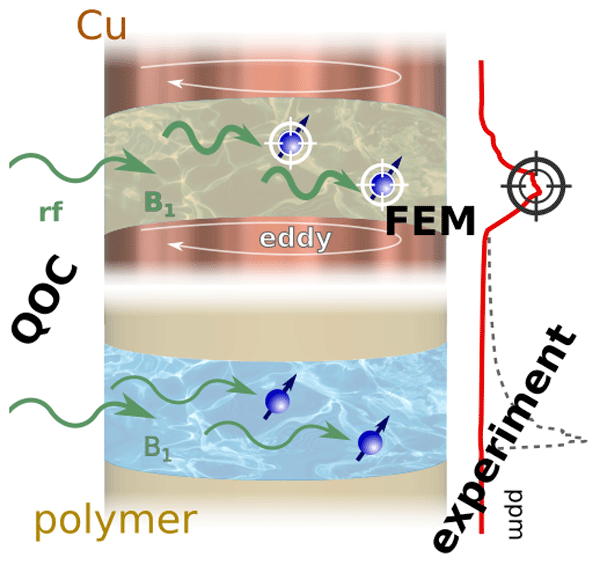
We developed a workflow using finite element methods to optimise electrochemical cell designs for in operando nuclear magnetic resonance by accurately matching magnetic field and radio frequency field simulations with experimental data. Guidelines for enhanced sensitivity and field homogeneity are given. A radio frequency amplification effect in coin cells is described by empirical formulae, which have the potential to improve spatial selectivity in future in operando applications.
We developed a workflow using finite element methods to optimise electrochemical cell designs...